Showing posts with label Battle of the Bulge. Show all posts

Thursday, July 20, 2017

WWII VETERAN HAS STAYED BUSY FOR 96 YEARS

Some entered World War II feeling they were born to fly.  Others felt born to sail.  Lynn Rachel knew he was born to drive a jeep.  “They made me an ammo carrier at first, but when the opportunity to drive a jeep came up, I jumped all over it!”
GREENSBORO'S LYNN RACHEL SAYS HE WAS BORN TO DRIVE A JEEP

Rachel logged a good number of stateside miles in Army jeeps, but the drive from Normandy to Austria is most memorable – the timeline of his war is marked by jeep events.
“We had to get our jeeps and trucks all fixed up before leaving the States, I must have fixed 40 flats one day!  I shouldn’t have worried, because when we got to England, I never saw so many jeeps – they were all brand spanking new!

We hiked and trained all over England, it seemed, but no one complained – we knew we were headed for the war zone soon.  In short order, I learned to drive my jeep on the wrong side of the road and to always carry a raincoat – it rained almost every day we were there.” 
   
On an LST landing craft headed to Normandy, Rachel learned about sailors, “They got upset because I didn’t tie my jeep down – I got upset because I couldn’t find any ropes or chains.  Fortunately, the seas were calm and my jeep stayed put.”

The Battle of the Bulge was on the horizon when the 99th Infantry Division made shore.  “We convoyed 200 miles towards Bastogne.  At first, the weather was decent so we were ordered to drive with windshields down and tops off.  The order never changed, even when it rained, and then snowed – I learned that was the Army way! 
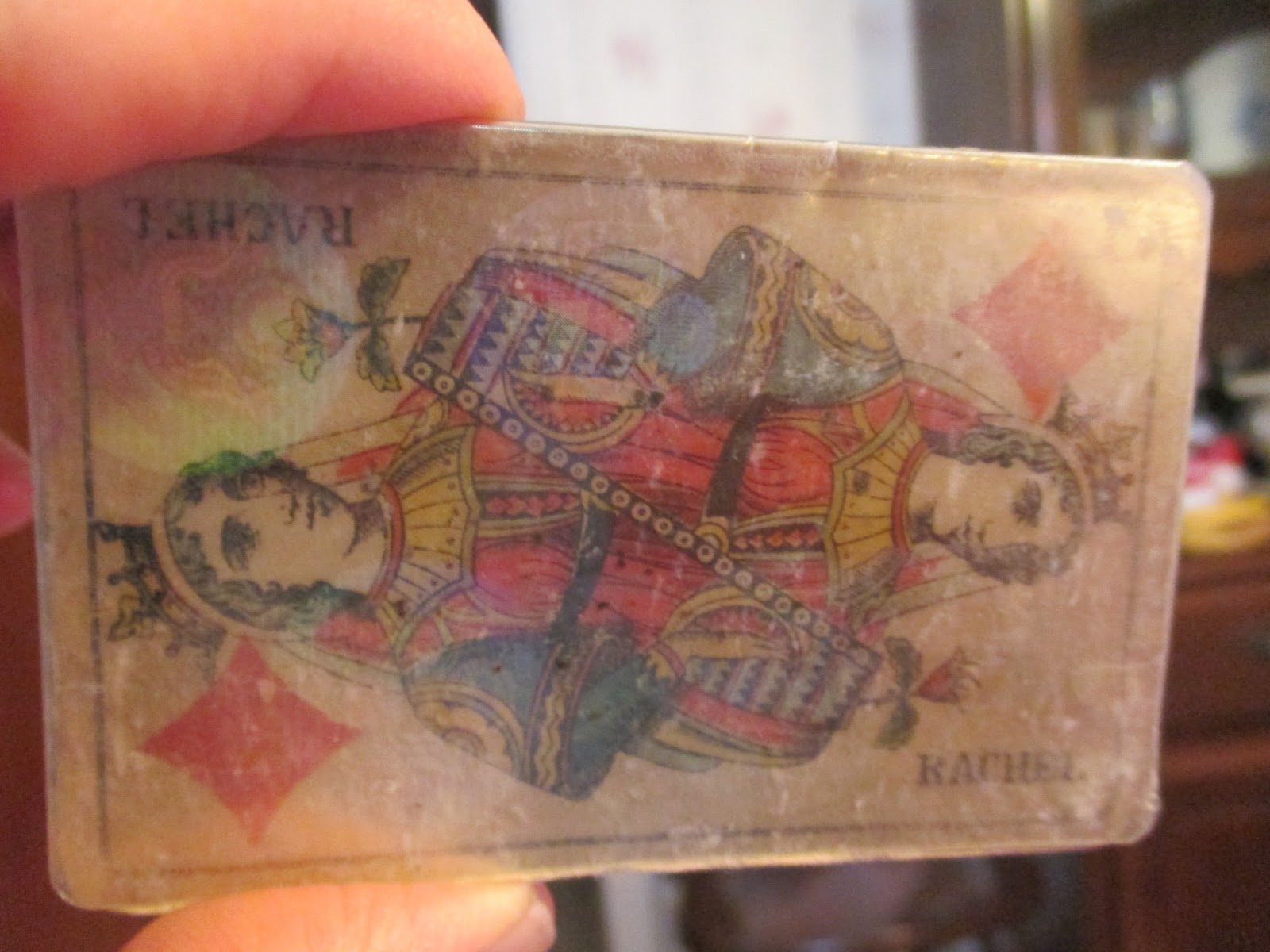
RACHEL FOUND DECK OF "RACHEL" GERMAN PLAYING CARDS IN PILLBOX

Major General Walter Lauer was our commanding officer -- he said he knew we could fight, and exhorted us to do it!”

Rachel’s division manned a 22-mile battle front under trying conditions and unfavorable odds, “The Germans stole our uniforms, weapons and even radio frequencies -- and used them all against us.”  The Germans made some advances, but the 99th Infantry Division held their sector.

With the arrival of better weather and General Patton’s 3rd Army, Allied forces prevailed.  The march toward Germany began.  Rachel had a marker for that too, “General Lauer stood on the hood of a jeep to tell us we did a good job and that the Germans were on the run.”  

Enemy pillboxes along the Siegfried Line were impressive to Rachel, “They were made of steel and concrete four feet thick, with steel doors like those on ships.”  Even more impressive was a deck of German playing cards he found in one of the pillboxes – engraved, “Rachel.”  He carries a “Rachel” card in his wallet to this day. 

Rachel was up close and personal with the race to the Rhine, “After Bastogne we moved north for a while before being ordered south.  After almost 300 miles we came upon the worst traffic jam I ever saw.”

The 99th Infantry Division was the first complete division to cross the Ludendorff Bridge at Remagen.  Ironically, Hitler had ordered the bridge destroyed after German troops withdrew.  The bridge withstood attacks from weaponry of all sorts: mortars, mines, howitzers, rockets, and Luftwaffe bombers.  It collapsed on its own, just days after the last U.S. troops crossed.
ONLY WEST COLUMNS OF BRIDGE AT REMAGEN REMAIN -- MUSEUM UNDERNEATH.  WRITER AND WIFE VISITED SITE DURING RV CARAVAN IN 2000 
“We proceeded up the Ruhr Valley and across Germany, liberating two concentration camps and collecting over 3,000 German prisoners,” recalls Rachel.

“We were just seven miles from Austria when V-E Day was announced.  After the war, a German general said nobody fought harder than the 99th Infantry Division.”

Before being drafted, Rachel worked at Proximity Mill – he returned to Proximity after the war and retired 40 years later.  Insisting that staying busy keeps you young, Rachel worked in maintenance at Four Seasons Mall for 27 years, retiring again in February, 2017. 

At 96, he lives by his “stay busy” mantra, “I go to the mall and walk four or five days a week.”  The day before I visited, he was busy trimming and mowing his yard.

He married Ruth Manuel in 1946; she died 15 years ago – they had one daughter, four grandchildren, and two great-grand-children.
RACHEL ENJOYS SHARING WW II MEMORIES WITH FRIENDS

Rachel and friends have met for coffee over the past 40 years.  At their bequest, on Rachel’s 95th birthday, Congressman Mark Walker presented him a flag that had flown over the U.S. Capitol, and a letter commemorating his service. 


His friends also submitted a copy of Battle Babies, a book written by General Lauer about the 99th Infantry Division, to the Virginia Military Institute library -- Rachel has a framed letter of acceptance.

Thursday, February 2, 2017

90-DAY WONDER NOW 95

Frank Heberer was one WW2 veteran I could hardly wait to write about.  He and I retired from the same company.  We were both from Mississippi.  Our Sears’ work-a-day paths often crossed.  He was an accountant – I was the accountee.  We both chose Greensboro for our retirement homes.

Heberer reflected, “I was raised on a farm.  When the price of cotton dipped to five cents per pound during the depression, we lost our land and my dad worked as a rural mail carrier.  I don’t know how he did it, but he scraped and managed to send me to Ole Miss.”

Heberer graduated from Ole Miss in 1943.  His timing for WW2 could not have been better.  “I was a ROTC graduate but they sent me to OCS at FT Benning as a Corporal.  In a matter of 13 weeks, I became a 90-day wonder,” he explains. 
LT. FRANK HEBERER 
    
LT. Heberer spent the early months of 1944 in Texas, training recruits bound for Infantry Replacement duty overseas.  Some of those trainees likely landed at Normandy on D-Day, June 6, 1944.  Heberer wasn’t far behind, “I walked ashore on Omaha Beach as a replacement officer on July 12.  I joined the 30th Infantry Division on August 14, 1944 – it was my 22nd birthday!”

It wasn’t lost on Heberer that the life expectancy of 2nd Lieutenant Platoon Leaders wasn’t good when he took over his platoon in Company F, 2nd Battalion, 120th Regiment, “I was a mighty lucky soldier!”

The 30th Infantry Division advanced across France and into Belgium, taking heavy casualties as they moved.  During the Battle of the Bulge, Heberer’s luck ran out.  He was wounded by shrapnel – on Christmas Day, 1944.
BATTLE OF THE BULGE CHRISTMAS GIFT WASN'T HEBERER'S FAVORITE

“I was evacuated to England for treatment and rehabilitation.  By the time I rejoined my outfit, it was just before VE-Day.  Our Division received good news, we would be among the first to return to the states – the bad news was we would immediately start training and equipping to invade Japan!”

Heberer and his 30th Infantry Division returned to the states aboard the Queen Mary.  The division had lost over 3000 men and over 13,000 were wounded in action.  Heberer earned a combat infantryman’s badge, two bronze stars with valor device, a purple heart and campaign ribbons for combat in Northern France, Rhineland and Ardennes.

 After one year, he was back in Germany as part of the U.S. Constabulary Force.  “Luckily, the war crimes trials had just ended, and the cold war had not begun yet.”

In 1948, Heberer left active duty for a job as comptroller with Sears in Greenville, MS, but remained in the Army Reserve.  I was lucky again -- when the Korean War started, they did not call me back.“  In 1949, in First Presbyterian Church of Canton, Mississippi, he married Elizabeth Shipley, his high school sweetheart. 
FRED BINDER LOOKS OVER HEBERER'S HIGHLY-VALUED
GERMAN WEAPON -- BINDER'S FATHER WAS ARMY OFFICER
WHO ALSO SERVED DURING THE WAR TRIALS
  
After an assignment in Jackson, MS, Heberer worked four years in Winston-Salem and 10 years in Charlotte.  In 1965, he came to Greensboro.  In 1987, he retired with 39 years of Sears service.

“I found it hard to work at Sears, start our family, and stay in the Reserve but they made me commanding officer of the Jackson, MS unit so I couldn’t quit at the moment.”  Heberer never got around to quitting – after 28 years of combined service, he retired as a full colonel.

For years, I kept track of Frank Heberer’s age by reading tennis box scores by age bracket on the city, state, southern and national level.  “I competed in U.S. Tennis Association Senior Tournaments for over 35 years,” Heberer says. 

The Mississippi native and his friend and long-time doubles partner, Dr. George Simkins, a black dentist and NAACP leader, may have raised a few eye-brows.  Their friendship extended far beyond the trophies and championships they won together.

The doubles team of Heberer/Simkins won multiple state championships in various age groups, often playing down into a younger bracket.  Heberer recalls, “George and I planned to play in the 2001 championship at Old Providence Racquet Club in Charlotte, but he withdrew when he learned it was NCA&T homecoming weekend.  George suffered an aneurysm at the football game and never recovered.” 

Heberer won the 1988 NC over 65 championship with Charlotte’s Bob Jones as his doubles partner.  Jones’ basketball-playing son, Bobby, may be better known in these parts. 

Heberer still looks, acts and talks like a tennis player, even though his tennis is relegated to television nowadays.  “My knees sidelined me in 2010.”  His last competitive tennis came at age 88. 
94-YEAR OLD RETIRED COLONEL PROUDLY FLIES OLD GLORY EVERY DAY

Married over 66 years, Elizabeth and Frank Heberer are members of First Presbyterian Church in Greensboro.  They have two grown sons and one grandson.   


Saturday, April 18, 2015

THE AIRBORNE: WHEN THE GOING GETS TOUGH, THE TOUGH GET GOING

Bill Lusk never intended his Mullens, WV, banker father to keep him from the draft, even as draft board head.  


To the contrary, Lusk was a rising junior in the accelerated ROTC program at Virginia Tech.  In April, 1943, it was his dad who gave him the not-unexpected news, “You’re going in.”
Bill Lusk, World War II Paratrooper/Glider Soldier
At Camp Mackall, NC, (just south of Southern Pines) Lusk joined the 193rd Glider Infantry Regiment, 17th Airborne Division.  The division moved to Tennessee for maneuvers and war games.


“The weather was terribly cold, lots of rain, sleet and snow,” Lusk recalls.  “One of our assault boats flooded while crossing a rain-swollen river, twelve men drowned.  We were told to keep moving, that’s the way it is in war!”


Early in 1944, the call went out for paratrooper volunteers. Lusk volunteered.  “I liked the self-sufficient, fight-to-survive paratrooper training, plus the $50 pay raise,” exclaimed Lusk.


August, 1944, was a whirlwind for Lusk and the 17th Airborne Division.  Troop-trained to Boston, they sailed for England. “We did glider exercises and maneuvers in England.  I believe the British had a fighter plane hid under every haystack,” reflects Lusk.


December 23, 1944, the entire 17th Airborne Division was air-lifted into France overnight.  “I landed at 2 a.m.  We rode trucks for a while, and walked the rest of Christmas Eve, the snow was 24-30 inches deep.”
Battle of  the Bulge
“During the Battle of the Bulge, we fought near Bastogne for control of Dead Man’s Ridge.”


“I was wounded by an 88mm artillery shell.  It landed right at my feet!  Two of my men were killed and many others were wounded.”  Lusk hallucinated in and out of consciousness, reasoning, “I’m not going to get out of here alive.”


“Resting my head in my helmet, I injected myself with morphine and prayed, Lord, I’m ready to come home!  I was sure that when I woke up, I would be in heaven!”


Providentially, two medics discovered Lusk was still alive as they came by verifying casualties.  “Those brave medics took me by stretcher to a field hospital, where surgeons removed multiple shrapnel fragments.”


Lusk’s surgery was done without anesthetics since all supplies of pain killers had been exhausted.  “They teased me that no rawhide was available, but gave me a piece of rubber to place between my teeth,” per Lusk.

Lusk was moved to France for further treatment and recuperation.  “On March 22, 1945, a jeep came to the hospital with orders for me.”  Taken to the 194th Glider Infantry Regiment, Lusk learned his 193rd Regiment has been so decimated at Dead Man’s Ridge, that survivors had been merged into the 194th.  


First, he learned, “We’re short a platoon sergeant, and you’re it!”   That placed Lusk in charge of three squads, each with twelve airborne infantrymen.


Secondly, Lusk learned they were just hours away from being dropped across the Rhine River into Germany, behind enemy lines.  
World War II Glider
On March 24, 1945, Lusk’s platoon boarded gliders, twelve men per glider.  They weren’t alone – over 900 USAF gliders were loading -- from multiple airfields.  Two gliders ferrying Lusk’s squad landed safely, but the third overshot the landing zone.  All twelve men and the glider pilot were killed by enemy fire.


By 2 p.m. Allied forces were in control, but running out of ammunition.  “Pilots risked their lives to fly low and drop us ammo.  Two planes were shot down and all crewmembers perished.”


Lusk’s platoon was later pinned down by enemy snipers operating from three large stone buildings.  “A British tank crew caught up with us.  I asked them to take the buildings out.  They did, and we moved on!”     


This was the final airborne operation of WW II, the first where glider troops and paratroopers dropped together, and the first where C-47s towed two gliders each.


Lusk came home on furlough after joining the 517th Paratrooper Infantry Regiment for the invasion of Japan.  The atomic bomb altered those plans.  Lusk earned a bronze star, purple heart, combat infantryman’s badge, parachutist badge, three campaign battle stars, invasion arrowhead, glider badge, M-1 expert’s badge and more.  


Lusk married Betty Williams, his childhood sweetheart on September 6, 1945.  After obtaining a B.S. degree in business administration with honors from Virginia Tech in 1947, he worked with Burlington Industries for forty years, retiring as Assistant Corporate Controller.


Bill and Betty Lusk are long-time members of First Baptist Church -- Greensboro, where both have had leadership roles.  They have three grown children and seven grands.  


Accepting thanks for his service, Lusk is appreciative but assertive, “Only by the grace of God am I here!”