Showing posts with label Army. Show all posts

Friday, July 21, 2017

GUILFORDIAN SERVED WITH HEAVY ARTILLERY

Herman “Red” Osborne, at 90, still walks softly, but he doesn’t carry the big stick his 741st Field Artillery unit carried during World War II.  His hair isn’t as red as it once was, but his eyes are still bright and engaging, especially when recounting his unit’s 227 days of continuous combat. 

Before being drafted in April, 1943, Osborne punched several Guilford tickets – he was born in Glenwood, lived in Colfax for a while, on a Climax tobacco farm after that, and back into Greensboro for work with J. A. Jones Construction Company until Uncle Sam called.

By his own admission, Osborne’s family was different, “In addition to my one brother and one sister, my parents raised one of my first cousins and one boy they took in from off the streets.” 

Osborne also punched several Army tickets – Fort Jackson, Camp Hood, the Tennessee Maneuvers, Camp Forrest, Liverpool, Normandy, and into the war zone. 
HERMAN OSBORNE HELPED CARRY A "BIG STICK"
“We moved 75 miles on September 14, 1944 to come in range of the enemy.  That night we surveyed our site, laid wire, positioned our guns, and at 10:30 fired our first combat round.  We had practiced a lot at Fort Jackson, and the folks in Columbia sometimes complained about the noise our guns made – but we made more noise the night of September 14 than all our practice firing combined,” recalls Osborne.

The standard light artillery piece in World War II was the 105mm howitzer, which had a 4.1 inch projectile.  Next largest piece was the 155mm howitzer, known as “Long Tom,” with a six inch projectile. 

Then there was the 203mm “big stick” of Osborne’s 741st Field Artillery Battalion, with an eight inch projectile.  According to literature provided by Osborne, “The eight-incher could change battle fortunes in short order.  It was ideal for clearing out concentrations of enemy troops and/or defeating fortified positions.  It was the largest self-propelled artillery piece available to us at the time.”
OSBORNE'S ARTILLERY PEERS ADDED NEW MEANING TO "HEAVY ARTILLERY!"

Typically, a crew of 14 operated each gun, which could fire an average of one 200-pound projectile each minute with a range of over 11 miles.

With the enemy in retreat, the 741st moved faster and more often.  “On April 25 we moved three times, no sooner than we set up, we took down and moved out,” says Osborne.  Other records show they took six positions in eight days, and on another occasion, moved five times in one week.

Osborne had a moment of doubt when they were ordered to cross the Moselle River on a temporary pontoon bridge, “Our guns weighed 17,000 pounds each – we gave one up for a test, but the bridge worked just fine.”

V-E Day (May 8, 1945) found the 741st in Augsburg, Germany.  Even though Osborne’s unit had been bombed, shelled, and strafed in their foray from Normandy to Augsburg, they had suffered minimal casualties.  Sadly, one of Osborne’s favorite officers was shot by a German civilian in late April and died on May 5. 

Osborne reflected, “Even after the surrender, German soldiers were hiding out all over the place, we never knew when we would run into one, or what their disposition would be.  One cornered himself in a haystack and would not come out, but others came forward willingly to give themselves up.

We fixed up a German motorcycle retrieved from a lake.  As we rode it around town, several enemy soldiers surrendered to us.  Occupation duty wasn’t all work, Bob Hope and Jack Benny put on shows for us, plus we visited Munich, Dachau, Oberammergau, Berchtesgaden and Paris.”  

The 741st spent the first week of August, 1945 on the firing range, ramping up for deployment to the Pacific theater for the invasion of Japan.  Even after V-J Day, the unit remained on occupation duty in Germany, returning to the states on January 6, 1946.  They wore campaign decorations for Normandy, Northern France, the Rhineland and Central Europe.

Two corporals from the 741st wrote, “A History of Charlie Battery,” quite a definitive combat journal.  Besides Osborne’s, the only other copy I could locate is in the U.S. Army Heritage and Education Center, Carlisle, PA.  
OSBORNE "WALKS SOFTLY," BUT AS A GREAT AMERICAN

On November 1, 1947, Osborne married Jean Loman.  They are members of Emmanuel Wesleyan Church and have three daughters, one son, eight grands, and nine great-grands.  Osborne worked as a heating and air conditioning technician with Dick and Kirkman for 38 years.


For the record, the two other boys from the Osborne household also served in World War II – Carl Osborne as a B-24 gunner and Tommy Younts as a paratrooper.
RECRUIT TRAINING TAKES DIFFERENT TWISTS

Military stories come in various shades of interest.  The era of service has a lot to do with the shade.  Seeing that Ted Russ’ two years of peace time military service coincided with two of my rather docile four years, I couldn’t fathom his story becoming a best seller.

A sizable segment of the population would beg to differ.

The son of a Fort Bragg barber, Russ graduated from Wake Forest College in 1955 with degrees in general science and education.   He was drafted into the Army the following year.
After basic and advanced training at Fort Hood, Texas, Russ deployed to Germany.  Perhaps in recognition of his college background, he traveled from base to base as a chemical, biological and radiological inspector/instructor in the Chemical Corps of the 2nd Armored Division.

His overseas deployment completed, Russ returned to Fort Hood where he instructed new Army inductees.  It is unknown how much an inductee from Tupelo, Mississippi remembered about his two-day training cycle on chemical, biological and radiological warfare, but Russ, his instructor, remembers the two days like yesterday.

While Russ doesn’t recall the names and times of all the soldiers he trained, he particularly remembers training Private Elvis Aaron Presley. 
TED RUSS AND HIS MOST FAMOUS TRAINEE

“We took groups of recruits out in the field for two days at the time.  It seemed that everyone in Texas knew Elvis was in recruit training at Fort Hood.  We knew he would come through our training cycle at some point.  I was quite inquisitive about how training the King of Rock and Roll would work out. 
 
Elvis was a good trainee and well-liked by his Army peers.  He took his celebrity status in stride.  He realized that learning how to use a gas mask was serious business and went through exactly the same training as all other recruits.  He asked no favors or for any special treatment,” Russ recalls.

Surely it was coincidental, but General Colin Powell also met Presley while on active duty.  According to Powell, “I saw him as Elvis Presley, the soldier – not as Elvis Presley the celebrity.”  Right.
RUSS RECALLED ELVIS PRESLEY COPED WELL WITH HIS CELEBRITY STATUS WHILE IN THE ARMY
Russ would not go so far as to say Presley was a typical Fort Hood doughboy, “His company was the only one that had gasoline-powered lawn mowers.  All other companies had push mowers – I always thought Elvis funded the gasoline mowers and the government funded the pushers.

Elvis did not perform for the public during his Army service, but his handlers released enough films and records to keep his fans in a frenzy.  Anytime his fans could get on base, long lines developed at the slightest hint of an Elvis sighting.”

Russ has several photos of Presley.  His personal favorite may be the photo of Russ and Presley together, “When we show that photo to friends, my wife always tells everyone that I am the good-looking one.”

About the time Presley deployed to Germany, Russ deployed to civilian life and returned to North Carolina, “Since I enjoyed teaching and instructing so much in the Army, I got a job teaching high school chemistry, biology and physics in Camden County, making $331 per month.”

Russ may have enjoyed teaching soldiers, but found that high school teaching wasn’t his forte, “I quit teaching and went to work for Breon Laboratories in pharmaceutical sales for ten years.”

After a stint with Key Homes in Greensboro, Russ formed Russ Realty Company in the early 1970s.  He retired in 2005.

Russ was a Baptist, but married a Methodist.  He readily admits his wife was the better salesperson – they are long-time members of West Market Street United Methodist Church. 
He and Carolyn Alston, whom he says was an avid Elvis Presley fan, were married in the Greensboro College Chapel on June 10, 1961.  They have four children, five grandchildren and four great-grandchildren. 
TED RUSS HAD A SMILE AND HANDSHAKE FOR EVERYONE 

While Russ has carefully preserved his 56-year old photos of Elvis Presley, I was surprised he had never attended an Elvis Presley concert – or visited Graceland, “I always wanted to do both, but just never got around to it,” he says. 

Disclosure – I married an Elvis fan who owned his every record.  We have been to Graceland.  We also enjoyed Elvis’ Greensboro Coliseum concert of April 21, 1977. 


Elvis Aaron Presley died August 17, 1977.  In addition to being a good soldier, he was the best-selling recording artist of all time.
VETERAN'S STORY HAS UNUSUAL TWISTS

Among the military veterans I’ve written about, Hank Brodt may have the shortest length of service – only two years active, three years reserve. On the other hand, the months and years he spent overseas during World War II compare most favorably with other veterans. 

Hank Brodt spent all of them overseas.   
 
More precisely, his wartime experience includes time in five German concentration camps, a three-day death march without food or water, and one forced labor camp. 

In addition to being a U.S. Army veteran, Hank Brodt is a Holocaust survivor.

Post-war, he testified at trials of accused Nazi war criminals at Dachau and Bremerhaven.

Liberated by the U.S. Army’s 80th Infantry Division on May 6, 1945, Brodt did kitchen patrol and odd jobs in the motor pool for Army occupation forces, “There wasn’t much pay involved, but I met many fine soldiers who befriended me – I learned a lot.”

After rotating back to the States, one of those soldiers sent Brodt paperwork towards visiting the United States and becoming a citizen.  Just four years after being liberated from a concentration camp, 24-year old Polish-born Hank Brodt immigrated to America.

While living in Chicago in 1950, he was drafted into the Army during the build-up for the Korean War.  Ironically, Brodt was sent to Germany, where he worked in the motor pool.
“After being discharged, I settled in New Jersey, married in 1952, and two beautiful daughters were born to my wife and me.  At this time, I have one grandson, one granddaughter, and two grand-Shelties!”

Brodt was under a year old when his father died.  As a child, he became the breadwinner for his mother.  He never saw her again after they were separated by the Germans in 1943. 

He never saw his brother again after he was drafted into the Russian Army.  “After years of searching, I did not find my brother but did eventually locate his widow.  She led me to my brother’s grave in Israel,” says Brodt.  Hank Brodt’s first wife died in 1978 and he remained single for over 20 years.
ADA AND HANK BRODT STAY BUSY WITH SPEAKING EVENTS

In 2000 Brodt married again.  Ada Brodt, who had been born in Russia, came to New Jersey in 1997.  Her father was Polish and had been taken as a prisoner of war by the Germans. 

She was college-trained as a construction engineer and worked for the Russian government, “When Gorbachev came into power, I was among a large number of people who lost their jobs and faced severe persecution.  A friend from Richmond, Virginia helped me obtain a guest visa and I later became an American citizen,” she says happily.

The Brodts moved  to High Point in 2005, they also have a home in Sparta.  They are active members of Temple Emanuel in Greensboro.

Brodt, now 90, is in high demand as a speaker and spends much of his time sharing his Holocaust experiences, “I want to tell others for the ones that didn’t make it!”  A retired carpenter, he is well-known and appreciated among Habitat for Humanity volunteers in Greensboro, where he used his carpentry skills many hours when his health was better.

Brodt makes annual excursions to Poland and Israel as part of the International March of the Living, an annual education program which brings individuals from all over the world to study the history of the Holocaust and to examine the roots of prejudice, intolerance and hate.

Greensboro businessman Don Freedman has an interesting take on the 2015 excursion.  “My son, Charlie, a high school junior, and I were looking forward to rooming together.  Instead, I was given 89-year old Hank Brodt as my room-mate. I was more than willing to help him with his baggage, but he kept offering to help me first – he is Mr. Energy!

It was an honor and privilege to travel and share rooms with Hank Brodt.  While memories were made that will last a lifetime, the timeliness is stark.  The Holocaust ended 71 years ago – the Hank Brodts of the world are becoming fewer by the day.”  

On May 5, 2016 Fort Bragg’s 18th Field Artillery Brigade sponsored the Holocaust Days of Remembrance ceremonies – Hank and Ada Brodt were honored guests.
COL. GUY TROY USA (RETIRED) WITH ADA AND HANK BRODT
GUY IS A WW II VETERAN WHO FIRST MET HANK DURING THE WAR TRIALS

Even though he lost his family and suffered through inhumane conditions throughout his youth, “I actually consider myself extremely fortunate, “ Brodt admits. 

The U. S. Holocaust Memorial Museum estimates over two million Jews died in German concentration camps.


Thursday, July 20, 2017

WWII VETERAN HAS STAYED BUSY FOR 96 YEARS

Some entered World War II feeling they were born to fly.  Others felt born to sail.  Lynn Rachel knew he was born to drive a jeep.  “They made me an ammo carrier at first, but when the opportunity to drive a jeep came up, I jumped all over it!”
GREENSBORO'S LYNN RACHEL SAYS HE WAS BORN TO DRIVE A JEEP

Rachel logged a good number of stateside miles in Army jeeps, but the drive from Normandy to Austria is most memorable – the timeline of his war is marked by jeep events.
“We had to get our jeeps and trucks all fixed up before leaving the States, I must have fixed 40 flats one day!  I shouldn’t have worried, because when we got to England, I never saw so many jeeps – they were all brand spanking new!

We hiked and trained all over England, it seemed, but no one complained – we knew we were headed for the war zone soon.  In short order, I learned to drive my jeep on the wrong side of the road and to always carry a raincoat – it rained almost every day we were there.” 
   
On an LST landing craft headed to Normandy, Rachel learned about sailors, “They got upset because I didn’t tie my jeep down – I got upset because I couldn’t find any ropes or chains.  Fortunately, the seas were calm and my jeep stayed put.”

The Battle of the Bulge was on the horizon when the 99th Infantry Division made shore.  “We convoyed 200 miles towards Bastogne.  At first, the weather was decent so we were ordered to drive with windshields down and tops off.  The order never changed, even when it rained, and then snowed – I learned that was the Army way! 
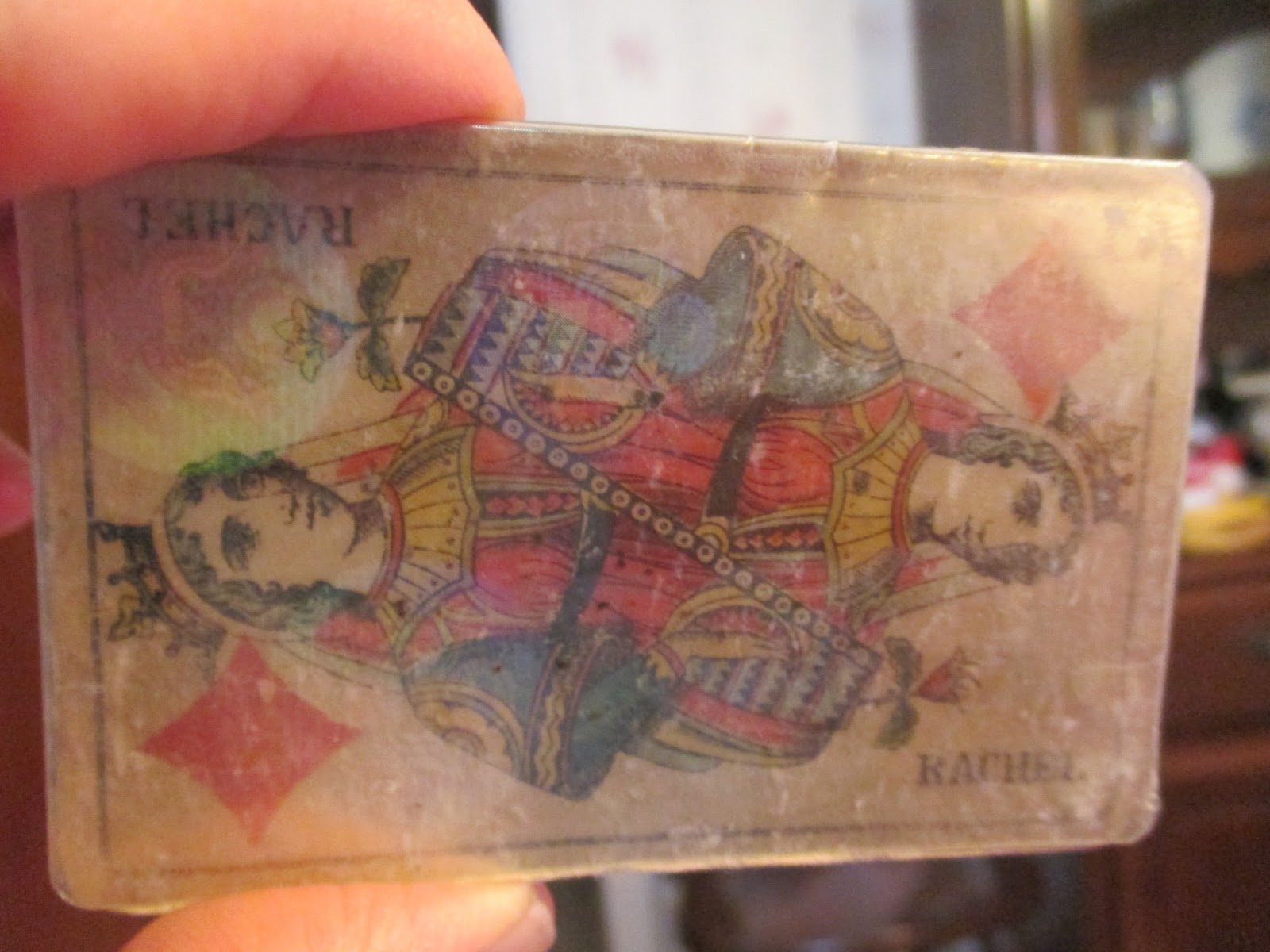
RACHEL FOUND DECK OF "RACHEL" GERMAN PLAYING CARDS IN PILLBOX

Major General Walter Lauer was our commanding officer -- he said he knew we could fight, and exhorted us to do it!”

Rachel’s division manned a 22-mile battle front under trying conditions and unfavorable odds, “The Germans stole our uniforms, weapons and even radio frequencies -- and used them all against us.”  The Germans made some advances, but the 99th Infantry Division held their sector.

With the arrival of better weather and General Patton’s 3rd Army, Allied forces prevailed.  The march toward Germany began.  Rachel had a marker for that too, “General Lauer stood on the hood of a jeep to tell us we did a good job and that the Germans were on the run.”  

Enemy pillboxes along the Siegfried Line were impressive to Rachel, “They were made of steel and concrete four feet thick, with steel doors like those on ships.”  Even more impressive was a deck of German playing cards he found in one of the pillboxes – engraved, “Rachel.”  He carries a “Rachel” card in his wallet to this day. 

Rachel was up close and personal with the race to the Rhine, “After Bastogne we moved north for a while before being ordered south.  After almost 300 miles we came upon the worst traffic jam I ever saw.”

The 99th Infantry Division was the first complete division to cross the Ludendorff Bridge at Remagen.  Ironically, Hitler had ordered the bridge destroyed after German troops withdrew.  The bridge withstood attacks from weaponry of all sorts: mortars, mines, howitzers, rockets, and Luftwaffe bombers.  It collapsed on its own, just days after the last U.S. troops crossed.
ONLY WEST COLUMNS OF BRIDGE AT REMAGEN REMAIN -- MUSEUM UNDERNEATH.  WRITER AND WIFE VISITED SITE DURING RV CARAVAN IN 2000 
“We proceeded up the Ruhr Valley and across Germany, liberating two concentration camps and collecting over 3,000 German prisoners,” recalls Rachel.

“We were just seven miles from Austria when V-E Day was announced.  After the war, a German general said nobody fought harder than the 99th Infantry Division.”

Before being drafted, Rachel worked at Proximity Mill – he returned to Proximity after the war and retired 40 years later.  Insisting that staying busy keeps you young, Rachel worked in maintenance at Four Seasons Mall for 27 years, retiring again in February, 2017. 

At 96, he lives by his “stay busy” mantra, “I go to the mall and walk four or five days a week.”  The day before I visited, he was busy trimming and mowing his yard.

He married Ruth Manuel in 1946; she died 15 years ago – they had one daughter, four grandchildren, and two great-grand-children.
RACHEL ENJOYS SHARING WW II MEMORIES WITH FRIENDS

Rachel and friends have met for coffee over the past 40 years.  At their bequest, on Rachel’s 95th birthday, Congressman Mark Walker presented him a flag that had flown over the U.S. Capitol, and a letter commemorating his service. 


His friends also submitted a copy of Battle Babies, a book written by General Lauer about the 99th Infantry Division, to the Virginia Military Institute library -- Rachel has a framed letter of acceptance.

Thursday, July 13, 2017

WHITSETT, NC VETERAN PUNCHED MANY TICKETS

Writing about veterans comes with distractions.  For example, when writing about Whitsett’s William Ira “Bill” Brown, one could easily be distracted by his years as a special investigator – think private eye.  Brown was chief investigator for a Richmond, VA insurance company and later for the Newport News Shipyards.  He moved to Whitsett in 2003 and formed his own private investigation company.
ARMY INFANTRY CAPTAIN AND RETIRED FBI SUPERVISOR
HAS MANY MEMORIES
Writing about his 23-year career with the Federal Bureau of Investigation could distract as well.  He served a year in Miami, FL; 12 years in Chicago, IL; and 10 years in Norfolk, VA.  He retired as Supervisor of Special Agents.  Writing about his service as a Supervisor of an Organized Crime Squad in Chicago is particularly tempting.

Or, we could write about Brown’s childhood – he was the eighth of eleven children born to a Jones County, NC tenant farmer – two died in infancy.  Brown was the last of his family to be delivered at home by the community mid-wife, Sister Miley Brock.  “I teased my younger siblings because they were ‘hospital babies’ (Parrott/Lenoir County Hospital in Kinston).

MARIAN BROWN SUTTON STILL LOVES HER LITTLE BROTHER
WHO LOVES HER BACK JUST AS MUCH
When we questioned where she got all those babies, Sister Brock insisted she found them in a ‘Stump Hole’ in the woods.”

The Brown family’s connection to NCA&T University could derail a veterans story. There is no Brown Building on campus, but Brown’s mother, Agnes Meadows Brown, was the school’s Mother of the Year in 1962.

With just cause -- her children; Thomas, Robert, Sadie, Marian, Raymond, Cecil, and Bill all attended NCA&T.  Leslie and Clement attended Davidson and Wake Forest University respectively.  The observation that all nine surviving children of a tenant farmer attended college could certainly take you off topic. 
   
Brown’s two years with the Peace Corps is a stand-alone story, but space only permits paragraphs.

“I was accepted by the Peace Corps during my sophomore year at NCA&T.  After three months of outward bound-type training at the University of New Mexico I joined a three-person team in Brazil.  Our team was politically correct – a German girl had health services, a Jewish guy had community development and I had agricultural extension.  We worked in a semi-arid part of the country – the main thing I remember -- most of the plants were thorny! 
We were paid a small stipend and $75 per month was placed in our bank accounts back home.  The stipend was small, but seemed large by Brazilian standards – when cashed, it amounted to a briefcase full of their currency.”

With Brown’s completion of Peace Corps service came his return to NCA&T and his eligibility for the draft.  “After summer school in 1965, I was drafted into the Army.  Following basic and advanced infantry training at Fort Gordon, GA I was assigned to the Live Fire Firing Range.”

Brown was selected for officer’s training school at Fort Benning, GA.  He graduated in November, 1966 -- tenth in his class of 150.  “I was assigned to my previous firing range at Fort Gordon.  Commanding the same soldiers I had served with as an enlisted man was interesting.  Fortunately, I knew which sergeants I could depend on to keep me from messing up!”

FORMER CAPTAIN BILL BROWN EXTREMELY
PROUD OF HIS "WOLFHOUND" SERVICE

It was more “when” than “if” that Brown would serve in Vietnam. “I arrived in country in April, 1967.  I took over a platoon in the 25th Infantry Division’s, Charlie Company 1/27 Infantry (Wolfhounds) on May 6, 1967 -- two of my men were killed that night.  I prayed to God for His protection to get me through Vietnam – thankfully, He did.”

PLATOON LEADER BILL BROWN TOOK HIS SOLDIERS ON DEADLY
MISSION HIS FIRST NIGHT IN VIETNAM

Brown lost one other man over the summer, and was wounded twice himself, but returned to combat duty after week-long hospital stays.  In November, 1967 he took over the 38th Infantry Scout Dog Platoon. “We had about 25 German Shepherds for scouting, another platoon used Labrador Retrievers for tracking.”

In May, 1968, Brown was assigned to Fort Riley, KS where he commanded a unit at the Army Correctional Training Facility.  “That was a tough job, we saw the underside of the draft, combat, and lowered standards.”

He was promoted to captain in 1968 and honorably discharged in 1969.  He married his childhood sweetheart from Jones County, NC.  They had two children before she passed away in 1996 from breast cancer.  Brown later married Greensboro’s Tina Akers, who had two children. They have six grands.

Should Brown write the book I have recommended, the story of the medic who nursed him back to health in Vietnam will be front and center.  “I heard a radio call that he had been hit.  Later, I learned he had lost both legs.  I’ve kept up with him over the years.  He has been teacher of the year in Florida and is a serious wheelchair sports competitor.”


Sunday, February 5, 2017

GLENWOOD HAD WW II GIRLS TOO


An iconic poster dominated the Greensboro community of Glenwood's landscape during WW II, entitled, GLENWOOD BOYS IN SERVICE.  This column offers equal opportunity recognition of a Glenwood girl.
POW WIDOW LOOKS OVER POSTER OF WW II
NEIGHBORS FROM GLENWOOD COMMUNITY
  
Helen Hayworth could have easily jumped to the conclusion she had picked the wrong G.I. for her beau.  Since platoon-sized groups of soldiers came and went from her Glenwood home for meals, parties, and fellowship, she had many to choose from. 

“Our house seemed to be a magnet for out-of-town soldiers.  My father would bring a carload of them home with him sometimes.  Many took their meals with us, but others  were happy just to sit around on the porch and talk,” Hayworth recalls. 

“They were all very nice.  The fact that my father was a Greensboro policeman may have had something to do with that.  My mother pampered them with food and attention.  She said, ‘I know someone would do the same for my boys.’  My brothers, Robert and Tommy served in World War II.”

While none of the soldiers who visited the Hayworth home passed Helen Hayworth’s  muster, one she met at a July 4th parade did.  “He was from the north, but I really liked him.  He came back to Greensboro on several weekends to see me.  He promised to write after he went overseas. 

I was so terribly disappointed when I didn’t hear from him for months on end!”

The truth be known, Corporal Antonio (Tony) Sanginite, a Brooklyn, New York native, may have written his southern belle while in route overseas.  Unfortunately, outgoing mail went down with his ship.  It was torpedoed by Luftwaffe bombers three miles off the African Coast in November, 1942.  Hours later, it was torpedoed by a German submarine, after which the USS Leedstown (AP-73) went down in 10 minutes.

Sanginite swam ashore and fought as an infantryman.  His 39th Infantry Regiment swept across North Africa until the Battle of the Kasserine Pass in February, 1943, where he was captured as a prisoner of war. 

Per Helen Hayworth, “Months after he promised to write, I finally heard from him – a solitary postcard notifying me he was a prisoner of war in Italy.  I couldn’t even write him back, there was no return address.” 

Meanwhile, Sanginite escaped from the POW Camp in Italy and rejoined U.S. forces, only to be captured again.  This time, he was imprisoned in Northern Germany.  This time, the war was over for him.
A SANGINITE GRANDSON SERVING AS ARMY OFFICER VISITED THE WW II GERMAN STALAG IN WHICH HIS GRANDFATHER WAS IMPRISONED AND BROUGHT THIS PAVER FROM THE RUINS FOR HIS GRANDMOTHER


For Helen Hayworth, it was another postcard – with no return address.

“Tony was liberated after VE-Day and came straight to Greensboro – he didn’t even go see his mother in New York.  When he knocked on the door of our house on Highland Avenue, I almost died! 

My sister had just married a returning veteran – they had a big church wedding.  I didn’t want a big wedding – I just wanted to marry Tony.  In less than a week, we had gone to York, South Carolina for our wedding.  It couldn’t have been better – the Justice of the Peace had a room all fixed up, a piano player, and everything!”

Tony Sanginite spent the rest of his life in Greensboro, working first as a mechanic and later with the post office.  Health ramifications, likely related to his POW experiences, took his life at the early age of 61.  The Sanginites have one daughter, Toni Price.

Helen Hayworth Sanginite is now 92.  She and Toni, along with Toni’s husband, Randy, remain active with the American Ex-Prisoner of War Association. 

The historic Glenwood Boys in Service poster, which hung for years in Glenwood’s Grove Street Café, was broken out at a recent AXPOW meeting.  Of the 200 photos, Sanginite knew most of them.  In some instances, “I don’t remember that boy’s name, but I remember where he lived.”

She has a cache of other memories as well, such as meeting Amelia Earhart, “I met Amelia through a friend, Jean Benson.  Jean lived out on High Point Road and flew her own plane.  Amelia visited her when she came to Greensboro.”

She also has memories of the Preddy brothers – preceding their World War II heroics.   “The Preddys were distant cousins.  When their family came to our home to visit, the Preddy boys tried their best to aggravate my sisters and me – they were very good at it.”

Sanginite attended McIver Elementary and Central Junior High Schools and graduated from Grimsley High School, class of 1941.

In addition to raising her daughter, she worked for Joseph Ruzicka Book Binders and Pilot Life Insurance Company.  An active member of the Greensboro’s First Moravian Church, she has taught Sunday School, sang in the choir and served as president of the Women’s Fellowship, “I always try to do what I’m asked.” 

She and her sister, Dorothy, served food at Potter’s House for over 20 years.
Should a poster of Glenwood girls who kept the World War II home fires burning be found, I expect Helen Hayworth Sanginite’s photo to be front and center.


Thursday, February 2, 2017

90-DAY WONDER NOW 95

Frank Heberer was one WW2 veteran I could hardly wait to write about.  He and I retired from the same company.  We were both from Mississippi.  Our Sears’ work-a-day paths often crossed.  He was an accountant – I was the accountee.  We both chose Greensboro for our retirement homes.

Heberer reflected, “I was raised on a farm.  When the price of cotton dipped to five cents per pound during the depression, we lost our land and my dad worked as a rural mail carrier.  I don’t know how he did it, but he scraped and managed to send me to Ole Miss.”

Heberer graduated from Ole Miss in 1943.  His timing for WW2 could not have been better.  “I was a ROTC graduate but they sent me to OCS at FT Benning as a Corporal.  In a matter of 13 weeks, I became a 90-day wonder,” he explains. 
LT. FRANK HEBERER 
    
LT. Heberer spent the early months of 1944 in Texas, training recruits bound for Infantry Replacement duty overseas.  Some of those trainees likely landed at Normandy on D-Day, June 6, 1944.  Heberer wasn’t far behind, “I walked ashore on Omaha Beach as a replacement officer on July 12.  I joined the 30th Infantry Division on August 14, 1944 – it was my 22nd birthday!”

It wasn’t lost on Heberer that the life expectancy of 2nd Lieutenant Platoon Leaders wasn’t good when he took over his platoon in Company F, 2nd Battalion, 120th Regiment, “I was a mighty lucky soldier!”

The 30th Infantry Division advanced across France and into Belgium, taking heavy casualties as they moved.  During the Battle of the Bulge, Heberer’s luck ran out.  He was wounded by shrapnel – on Christmas Day, 1944.
BATTLE OF THE BULGE CHRISTMAS GIFT WASN'T HEBERER'S FAVORITE

“I was evacuated to England for treatment and rehabilitation.  By the time I rejoined my outfit, it was just before VE-Day.  Our Division received good news, we would be among the first to return to the states – the bad news was we would immediately start training and equipping to invade Japan!”

Heberer and his 30th Infantry Division returned to the states aboard the Queen Mary.  The division had lost over 3000 men and over 13,000 were wounded in action.  Heberer earned a combat infantryman’s badge, two bronze stars with valor device, a purple heart and campaign ribbons for combat in Northern France, Rhineland and Ardennes.

 After one year, he was back in Germany as part of the U.S. Constabulary Force.  “Luckily, the war crimes trials had just ended, and the cold war had not begun yet.”

In 1948, Heberer left active duty for a job as comptroller with Sears in Greenville, MS, but remained in the Army Reserve.  I was lucky again -- when the Korean War started, they did not call me back.“  In 1949, in First Presbyterian Church of Canton, Mississippi, he married Elizabeth Shipley, his high school sweetheart. 
FRED BINDER LOOKS OVER HEBERER'S HIGHLY-VALUED
GERMAN WEAPON -- BINDER'S FATHER WAS ARMY OFFICER
WHO ALSO SERVED DURING THE WAR TRIALS
  
After an assignment in Jackson, MS, Heberer worked four years in Winston-Salem and 10 years in Charlotte.  In 1965, he came to Greensboro.  In 1987, he retired with 39 years of Sears service.

“I found it hard to work at Sears, start our family, and stay in the Reserve but they made me commanding officer of the Jackson, MS unit so I couldn’t quit at the moment.”  Heberer never got around to quitting – after 28 years of combined service, he retired as a full colonel.

For years, I kept track of Frank Heberer’s age by reading tennis box scores by age bracket on the city, state, southern and national level.  “I competed in U.S. Tennis Association Senior Tournaments for over 35 years,” Heberer says. 

The Mississippi native and his friend and long-time doubles partner, Dr. George Simkins, a black dentist and NAACP leader, may have raised a few eye-brows.  Their friendship extended far beyond the trophies and championships they won together.

The doubles team of Heberer/Simkins won multiple state championships in various age groups, often playing down into a younger bracket.  Heberer recalls, “George and I planned to play in the 2001 championship at Old Providence Racquet Club in Charlotte, but he withdrew when he learned it was NCA&T homecoming weekend.  George suffered an aneurysm at the football game and never recovered.” 

Heberer won the 1988 NC over 65 championship with Charlotte’s Bob Jones as his doubles partner.  Jones’ basketball-playing son, Bobby, may be better known in these parts. 

Heberer still looks, acts and talks like a tennis player, even though his tennis is relegated to television nowadays.  “My knees sidelined me in 2010.”  His last competitive tennis came at age 88. 
94-YEAR OLD RETIRED COLONEL PROUDLY FLIES OLD GLORY EVERY DAY

Married over 66 years, Elizabeth and Frank Heberer are members of First Presbyterian Church in Greensboro.  They have two grown sons and one grandson.   


Wednesday, February 1, 2017

SUITCASE HOLDS CACHE OF MEMORIES

The phrase, “Living out of a suitcase,” means more to 92-year old Jane Doner Fredrickson than to some. 
PRE-WWII SUITCASE AT LEAST 84 YEARS OLD
STILL HOLD TREASURE CACHE OF INFORMATION
 
Along with her mother and sister, Fredrickson lived out of a suitcase during almost three years of Japanese imprisonment during World War II, “That suitcase was given to me by my grandmother in 1933.  She impressed upon me how different it was from most suitcases, inasmuch as it had linings.”
LEZAH ANDERSON ARNEY, ANN FREDRICKSON WILLIAMS,
JANE FREDRICKSON, & TONI SANGINITE PRICE.
ARNEY, WILLIAMS & PRICE ARE CHILDREN OF WW II POWS
FREDRICKSON WAS A CIVILIAN WW II POW
Jane Doner Fredrickson than to some.  Along with her mother and sister, she lived out of a suitcase during almost three years of Japanese imprisonment during World War II, “That suitcase was given to me by my grandmother in 1933.  She impressed upon me how different it was from most suitcases, inasmuch as it had linings.”


Fredrickson was born on the Island of Cebu in the Philippines to school-teaching parents.  Her father taught several years before associating with a coconut plantation on the Island of Mindanao – her mother continued to teach in Cebu.  Jane Fredrickson attended the all-girls Santa Teresa Academy.  She was the only American in her school. 

All was well with the Doners.

Then came the war.

 “My father couldn’t get back to Cebu, so when evacuation was ordered on Christmas Day, 1941, my mother, sister and I left for the hills along with other American and British civilians,” Fredrickson reflected recently.  “I volunteered to work on the waterfront, but when the Japanese started bombing the docks, my supervisor, an Army colonel, said he needed a man who could jump on a truck and carry a gun.  At that time, I wished I had been a boy!

About 15 families stayed in two houses on a sugar plantation for a few days, but when we heard Manila had fallen we moved further into the hills.  We lived in bamboo huts with nipa thatch roofs until May 1, 1942 when we surrendered to the Japanese.

Imprisoned on Cebu, we were first kept in a house, then a jail, and eventually moved to an abandoned junior college building, formerly used as a barracks by Japanese troops.  The building and grounds were indescribably filthy!

In October, we were moved to Club Filipino, a wooden building with thatched roof.    In December, 1942 we went aboard a Japanese ship – five days later we reached Manila and were taken to Santo Tomas.  We remained there until liberated by American troops almost three years later.”

A few housekeeping items are in order here:  Manila’s University of Santo Tomas was taken over by the Japanese and used as their largest internment center.  Upward to 3700 Americans were imprisoned at Santo Tomas, more than at any other location. 

Jane Fredrickson’s father, Landis Doner, survived the Mindanao Death March after his capture.  In January, 1944 he was moved to Santo Tomas – the family was together again, but not under the most favorable of circumstances. 

During the battle to retake the Philippines, Allied Forces bombed Japanese facilities in Manila and Santo Tomas was shelled by the Japanese. 

The rest of the world learned about Santo Tomas in the March 5, 1945 issue of Life Magazine.  According to Life, “The liberated Americans were sick, hungry and subdued.”  Jane Fredrickson this as a vast understatement.

She would know.  Should she forget, there are the three versions of her diary for reference.  She has the rough draft, written on scraps of paper as inconsequential as Japanese cigarette pack wrappers.  Later came a hand-written transcription and finally, a typed version.
WW II PRISONER OF WAR KEPT DAY BY DAY JOURNAL OF CAPTIVITY

“The Japanese guards routinely confiscated and destroyed personal diaries.  I was caught writing in my diary, but they let me continue when told I was doing school work.”

Fredrickson had entrusted a Filipino friend with her Cebu diary, “Wrapped in oilcloth, he buried it under his bamboo house.  After the war, we made contact and he shipped the diary to me.  In the meantime, he and his wife had a daughter – they named her Jane!”

During her imprisonment, Fredrickson found out just how wise her grandmother had been, “I kept writing every day, the linings in the suitcase made wonderful hiding places.”
WRITER MOST APPRECIATIVE OF GREAT AMERICAN
SHARING HER TREASURED MEMORABILIA

After the war, Jane Doner Fredrickson graduated from Penn State University, where she met and later married Robert A. Fredrickson, a World War II cryptographer.  The family moved to Greensboro in 1949.  He taught history and music at Greensboro/Grimsley High School for 35 years.  She taught Spanish and English at four Greensboro Middle Schools.  Robert Fredrickson died March 13, 2015 at 91.

The Fredricksons had two children, Ann Fredrickson Williams and Craig Fredrickson, as well as four grandchildren.

In 1992, Jane Fredrickson received a letter from Santa Teresa Academy, “They invited our senior class back for our official graduation – 50 years later.  I was honored to be the keynote speaker.”


She is an optimist, as her mother must have been – Millicent Doner wrote to her hometown newspaper as Santo Tomas was being liberated, “We are fashionably thin due to slow starvation.  We’ve had narrow escapes and shells are flying over our heads as I write, but no one is afraid – our Boys (American GIs) are here now!”