Showing posts with label WWII. Show all posts

Thursday, July 20, 2017

WWII VETERAN HAS STAYED BUSY FOR 96 YEARS

Some entered World War II feeling they were born to fly.  Others felt born to sail.  Lynn Rachel knew he was born to drive a jeep.  “They made me an ammo carrier at first, but when the opportunity to drive a jeep came up, I jumped all over it!”
GREENSBORO'S LYNN RACHEL SAYS HE WAS BORN TO DRIVE A JEEP

Rachel logged a good number of stateside miles in Army jeeps, but the drive from Normandy to Austria is most memorable – the timeline of his war is marked by jeep events.
“We had to get our jeeps and trucks all fixed up before leaving the States, I must have fixed 40 flats one day!  I shouldn’t have worried, because when we got to England, I never saw so many jeeps – they were all brand spanking new!

We hiked and trained all over England, it seemed, but no one complained – we knew we were headed for the war zone soon.  In short order, I learned to drive my jeep on the wrong side of the road and to always carry a raincoat – it rained almost every day we were there.” 
   
On an LST landing craft headed to Normandy, Rachel learned about sailors, “They got upset because I didn’t tie my jeep down – I got upset because I couldn’t find any ropes or chains.  Fortunately, the seas were calm and my jeep stayed put.”

The Battle of the Bulge was on the horizon when the 99th Infantry Division made shore.  “We convoyed 200 miles towards Bastogne.  At first, the weather was decent so we were ordered to drive with windshields down and tops off.  The order never changed, even when it rained, and then snowed – I learned that was the Army way! 
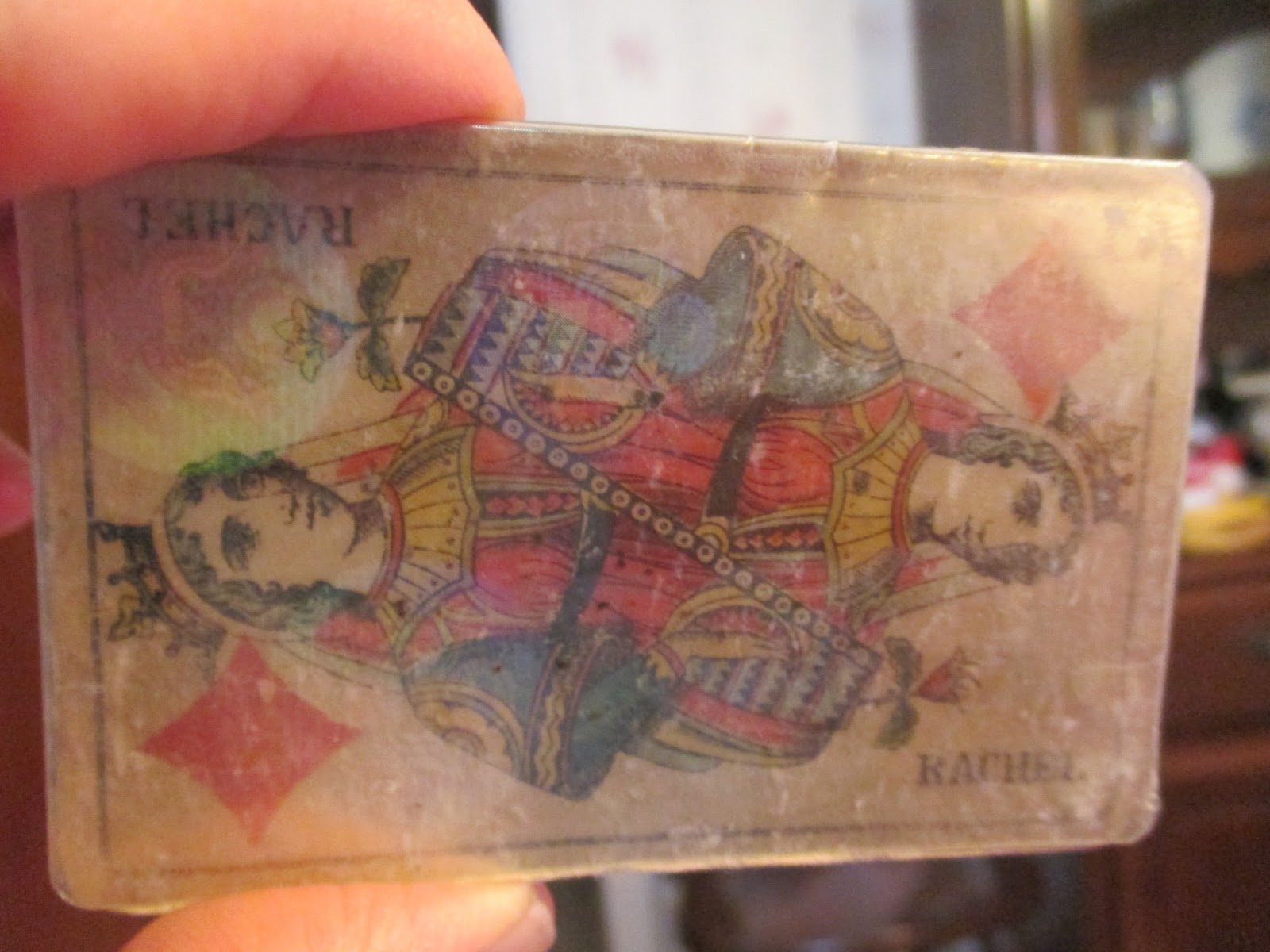
RACHEL FOUND DECK OF "RACHEL" GERMAN PLAYING CARDS IN PILLBOX

Major General Walter Lauer was our commanding officer -- he said he knew we could fight, and exhorted us to do it!”

Rachel’s division manned a 22-mile battle front under trying conditions and unfavorable odds, “The Germans stole our uniforms, weapons and even radio frequencies -- and used them all against us.”  The Germans made some advances, but the 99th Infantry Division held their sector.

With the arrival of better weather and General Patton’s 3rd Army, Allied forces prevailed.  The march toward Germany began.  Rachel had a marker for that too, “General Lauer stood on the hood of a jeep to tell us we did a good job and that the Germans were on the run.”  

Enemy pillboxes along the Siegfried Line were impressive to Rachel, “They were made of steel and concrete four feet thick, with steel doors like those on ships.”  Even more impressive was a deck of German playing cards he found in one of the pillboxes – engraved, “Rachel.”  He carries a “Rachel” card in his wallet to this day. 

Rachel was up close and personal with the race to the Rhine, “After Bastogne we moved north for a while before being ordered south.  After almost 300 miles we came upon the worst traffic jam I ever saw.”

The 99th Infantry Division was the first complete division to cross the Ludendorff Bridge at Remagen.  Ironically, Hitler had ordered the bridge destroyed after German troops withdrew.  The bridge withstood attacks from weaponry of all sorts: mortars, mines, howitzers, rockets, and Luftwaffe bombers.  It collapsed on its own, just days after the last U.S. troops crossed.
ONLY WEST COLUMNS OF BRIDGE AT REMAGEN REMAIN -- MUSEUM UNDERNEATH.  WRITER AND WIFE VISITED SITE DURING RV CARAVAN IN 2000 
“We proceeded up the Ruhr Valley and across Germany, liberating two concentration camps and collecting over 3,000 German prisoners,” recalls Rachel.

“We were just seven miles from Austria when V-E Day was announced.  After the war, a German general said nobody fought harder than the 99th Infantry Division.”

Before being drafted, Rachel worked at Proximity Mill – he returned to Proximity after the war and retired 40 years later.  Insisting that staying busy keeps you young, Rachel worked in maintenance at Four Seasons Mall for 27 years, retiring again in February, 2017. 

At 96, he lives by his “stay busy” mantra, “I go to the mall and walk four or five days a week.”  The day before I visited, he was busy trimming and mowing his yard.

He married Ruth Manuel in 1946; she died 15 years ago – they had one daughter, four grandchildren, and two great-grand-children.
RACHEL ENJOYS SHARING WW II MEMORIES WITH FRIENDS

Rachel and friends have met for coffee over the past 40 years.  At their bequest, on Rachel’s 95th birthday, Congressman Mark Walker presented him a flag that had flown over the U.S. Capitol, and a letter commemorating his service. 


His friends also submitted a copy of Battle Babies, a book written by General Lauer about the 99th Infantry Division, to the Virginia Military Institute library -- Rachel has a framed letter of acceptance.

Wednesday, February 1, 2017

SUITCASE HOLDS CACHE OF MEMORIES

The phrase, “Living out of a suitcase,” means more to 92-year old Jane Doner Fredrickson than to some. 
PRE-WWII SUITCASE AT LEAST 84 YEARS OLD
STILL HOLD TREASURE CACHE OF INFORMATION
 
Along with her mother and sister, Fredrickson lived out of a suitcase during almost three years of Japanese imprisonment during World War II, “That suitcase was given to me by my grandmother in 1933.  She impressed upon me how different it was from most suitcases, inasmuch as it had linings.”
LEZAH ANDERSON ARNEY, ANN FREDRICKSON WILLIAMS,
JANE FREDRICKSON, & TONI SANGINITE PRICE.
ARNEY, WILLIAMS & PRICE ARE CHILDREN OF WW II POWS
FREDRICKSON WAS A CIVILIAN WW II POW
Jane Doner Fredrickson than to some.  Along with her mother and sister, she lived out of a suitcase during almost three years of Japanese imprisonment during World War II, “That suitcase was given to me by my grandmother in 1933.  She impressed upon me how different it was from most suitcases, inasmuch as it had linings.”


Fredrickson was born on the Island of Cebu in the Philippines to school-teaching parents.  Her father taught several years before associating with a coconut plantation on the Island of Mindanao – her mother continued to teach in Cebu.  Jane Fredrickson attended the all-girls Santa Teresa Academy.  She was the only American in her school. 

All was well with the Doners.

Then came the war.

 “My father couldn’t get back to Cebu, so when evacuation was ordered on Christmas Day, 1941, my mother, sister and I left for the hills along with other American and British civilians,” Fredrickson reflected recently.  “I volunteered to work on the waterfront, but when the Japanese started bombing the docks, my supervisor, an Army colonel, said he needed a man who could jump on a truck and carry a gun.  At that time, I wished I had been a boy!

About 15 families stayed in two houses on a sugar plantation for a few days, but when we heard Manila had fallen we moved further into the hills.  We lived in bamboo huts with nipa thatch roofs until May 1, 1942 when we surrendered to the Japanese.

Imprisoned on Cebu, we were first kept in a house, then a jail, and eventually moved to an abandoned junior college building, formerly used as a barracks by Japanese troops.  The building and grounds were indescribably filthy!

In October, we were moved to Club Filipino, a wooden building with thatched roof.    In December, 1942 we went aboard a Japanese ship – five days later we reached Manila and were taken to Santo Tomas.  We remained there until liberated by American troops almost three years later.”

A few housekeeping items are in order here:  Manila’s University of Santo Tomas was taken over by the Japanese and used as their largest internment center.  Upward to 3700 Americans were imprisoned at Santo Tomas, more than at any other location. 

Jane Fredrickson’s father, Landis Doner, survived the Mindanao Death March after his capture.  In January, 1944 he was moved to Santo Tomas – the family was together again, but not under the most favorable of circumstances. 

During the battle to retake the Philippines, Allied Forces bombed Japanese facilities in Manila and Santo Tomas was shelled by the Japanese. 

The rest of the world learned about Santo Tomas in the March 5, 1945 issue of Life Magazine.  According to Life, “The liberated Americans were sick, hungry and subdued.”  Jane Fredrickson this as a vast understatement.

She would know.  Should she forget, there are the three versions of her diary for reference.  She has the rough draft, written on scraps of paper as inconsequential as Japanese cigarette pack wrappers.  Later came a hand-written transcription and finally, a typed version.
WW II PRISONER OF WAR KEPT DAY BY DAY JOURNAL OF CAPTIVITY

“The Japanese guards routinely confiscated and destroyed personal diaries.  I was caught writing in my diary, but they let me continue when told I was doing school work.”

Fredrickson had entrusted a Filipino friend with her Cebu diary, “Wrapped in oilcloth, he buried it under his bamboo house.  After the war, we made contact and he shipped the diary to me.  In the meantime, he and his wife had a daughter – they named her Jane!”

During her imprisonment, Fredrickson found out just how wise her grandmother had been, “I kept writing every day, the linings in the suitcase made wonderful hiding places.”
WRITER MOST APPRECIATIVE OF GREAT AMERICAN
SHARING HER TREASURED MEMORABILIA

After the war, Jane Doner Fredrickson graduated from Penn State University, where she met and later married Robert A. Fredrickson, a World War II cryptographer.  The family moved to Greensboro in 1949.  He taught history and music at Greensboro/Grimsley High School for 35 years.  She taught Spanish and English at four Greensboro Middle Schools.  Robert Fredrickson died March 13, 2015 at 91.

The Fredricksons had two children, Ann Fredrickson Williams and Craig Fredrickson, as well as four grandchildren.

In 1992, Jane Fredrickson received a letter from Santa Teresa Academy, “They invited our senior class back for our official graduation – 50 years later.  I was honored to be the keynote speaker.”


She is an optimist, as her mother must have been – Millicent Doner wrote to her hometown newspaper as Santo Tomas was being liberated, “We are fashionably thin due to slow starvation.  We’ve had narrow escapes and shells are flying over our heads as I write, but no one is afraid – our Boys (American GIs) are here now!” 

Saturday, December 3, 2016

13NOV1944 WASN'T A GOOD DAY FOR THESE SOLDIERS

On the other hand, in August, 2016, the two World War II veterans couldn’t stop toasting each other – with bottled Coca-Colas – spiked with salted peanuts.

WW II PURPLE HEART VETERANS SALUTE EACH OTHER

William Henry Long and Milton Percy Stanfield graduated in the early 1940s from Summerfield and Monticello High Schools, respectively.  Given their era, being drafted wasn’t “if,” but “when.”  They did odd jobs such as farming, driving trucks and building boats in the interim.  The interim was a bit longer in those days – high school graduation came after the 11th grade.

Their paths did not cross before leaving to serve their country.

Long landed on Omaha Beach in mid-July, 1944.  Stanfield landed on Utah Beach a short time later.  Both joined the 315th Infantry Regiment of the 79th Infantry Division as replacements.

MILTON STANFIELD, BAR-MAN, 79TH ID

DOC LONG, BAZOOKA-MAN, 79TH ID

Even though they were in the same Division and Regiment -- Long as a bazooka-man in Company G, Stanfield as a BAR-man in Company E -- their paths did not cross.

Since the French language had not been taught at Summerfield or Monticello High Schools, a French dictionary would have served Long and Stanfield well.  In weeks, they had bridged, boated, waded or swam across rivers such as the Ay, Sarthe, Seine, Moselle, and Meurthe -- and liberated towns such as Flottenan, Cherbourg, La Haye de Puits, Laval, LeMans and Charmes. 
 
In a rush to reach the Franco-Belgian border, the entire 79th Division moved 180 miles in 72 hours – they were among first American G.I.s to enter Belgium.  According to Major General Charles H. Corbett, “That was one of the fastest opposed advances by a division in the history of warfare.”

While street-fighting and house-to-house combat had been the order of the day, clearing the Foret de Parroy was quite different.  Both Long and Stanfield recall the dense woods, lack of roads, and a steady diet of mud, rain and fatigue.  They have even more unpleasant memories of the determined German defense of tanks, artillery and mortars.

Long recalls, “By that time, we had taken huge numbers of German prisoners of war.  We had to move them as we moved.  We just put a rope around them, they weren’t too interested in escaping.”

After 127 days of continuous combat -- on Tuesday, October 24, 1944 -- the 315th Infantry Regiment paused for rest near Luneville, France.  Even during this offline period, the paths of Long and Stanfield did not cross. 

At 7 a.m., on Monday, November 13, after what must have felt like the shortest 20 days of their lives, troops of Companies G and E of the 315th Infantry Regiment went back into the lines. 

On that fateful day, Stanfield went down first, struck in his arm, hand and leg by shrapnel, “I received a purple heart, but felt like I earned three of them – shrapnel burns skin, cuts arteries and breaks bones!”  After treatment in three Army hospitals, he returned to limited duty for the duration of the war.

Long, a bazooka-man himself, went down at 3 p.m. wounded by shrapnel from a German bazooka shell.  With severed nerves and a major artery cut in his right arm, he was wounded a second time in his other shoulder and arm when a mortar shell exploded nearby.  He was rescued after lying on the frozen battlefield for 18 hours. 

Long recalls, “The below freezing temperature and the fact I had on seven layers of clothing, turned out to be a blessing -- otherwise I would have probably bled to death before they got to me.”

With his right arm paralyzed since the war, Long asked a general if he could salute with his left hand, “He told me to stand tall and proudly salute with what I had left!”

Stanfield, now 93, returned to his Triad roots, raised his family, worked at the Sears Catalog Plant for 37 years, and retired to Madison.

William Henry Long, now 92 -- and much better known as “Doc” Long -- returned to his Summerfield roots, raised his family, and co-founded Long Brothers of Summerfield, Asphalt Paving of Greensboro and Hilco Transport Company. 

Long’s philanthropy is significant and far-reaching.  Beyond community and church, he funded a war memorial in the small French village of Ancerviller, where he was wounded in 1944. 

According to Carolina Field of Honor founder, Bill Moss, “Doc Long jump-started our capital fund-raising – we couldn’t have made it without him.”

TWO 79TH ID WW II WARRIORS MEET FOR FIRST TIME, 72 YEARS AFTER THEY
BOTH WON PURPLE HEARTS ON THE SAME DAY, ON THE SAME BATTLEFIELD
PATTY LONG HILL ARRANGED THE MEETING

Decades after landing at Normandy, the paths of Doc Long and Milton Stanfield finally crossed.  Their daughters, Patty Long-Hill and Emily Oakley, made it happen.  Two World War II foot soldiers, two men of strong faith, too long for their paths to cross, but the crossing left notes and memories -- far beyond toasting with Cokes, spiked with salted peanuts.

WW II BAR-MAN, WWII BAZOOKA-MAN, & PEACE-TIME MARINE
MILTON STANFIELD, DOC LONG, HARRY THETFORD
16AUGUST2016


WORLD WAR II DAUGHTER REMEMBERS 
D-DAY QUITE WELL

While it was an extraordinarily busy Tuesday around the office of Marjorie Moore’s father, he found time to write his oldest daughter a two-page birthday letter, “My little lady, sorry that I can’t be with you today, but pray to God that we will be together for your 10th birthday.”  

COLONEL E. WALTER MOORE
 He apologized for not having time to shop for an appropriate gift to mark the occasion.  He commended her on the glowing dance recital report he had received from her mother.  He reminded her she was the role model for her younger sister, and to help their mother out as much as possible. 

Since her father was a West Point graduate and career military officer, the Moore family was accustomed to family separations – many more were to come. 

Marjorie Moore had received similar letters before, but this one seemed different.  In closing, her father hinted that the day was particularly memorable -- and that she would understand later.

COL. MOORE (L) DURING WORLD WAR II

She understood sooner than later.  Her father was Colonel E. Walter Moore, U. S. Army Air Forces.  He was stationed in England.  He commanded the 30th Air Depot Group of the 9th Air Force. 

The day was June 6, 1944 – D-Day!

Even though Colonel Moore was a decorated Command Pilot and would log over 11,000 hours of flight time, he wasn’t flying on D-Day.  He was tasked to keep other B-26 Marauder Bombers under his charge in the air.  The first 56 had taken off at 4 a.m.  The fact that many of his B-26s flew more than one mission on D-Day was a tribute to Moore’s support personnel on the ground. 

At the time, Marjorie’s mother and the two daughters were living with grandparents in Little Rock, Arkansas, “I attended a small private Catholic school.  Each day, we would be taken into the auditorium and shown movies and news clips of how the war was unfolding.  I knew my father was over there someplace and that it was horrible.”

Colonel Moore missed Marjorie’s 10th birthday as well.  This time, his Martin Marauder bombers were kept busy repatriating American prisoners of war and moving soldiers back towards home.

COL MOORE BEING DECORATED BY FRENCH GENERAL

Her 11th birthday showed a brief touch of normalcy – albeit overseas -- the family was all together at Erlangen, Germany.  The family spent Marjorie’s 12th birthday together in Paris, after which Colonel Moore transferred to Eglin Field, Florida.  By this time, Marjorie had become a Christian and started a strong pilgrimage of faith that continues to this day. 

So much for normalcy, she attended schools at Fort Walton Beach, Florida for 9th grade; Fort Worth, Texas for 10th ; Eielson Air Force Base, Alaska for 11th; and Falls Church, Virginia for her senior year.

She doesn’t expect sympathy for changing schools every year, “It was actually lots of fun!  Our high school in Alaska consisted of a 9th grade boy and me!  I was a shoo-in for most beautiful, most intellectual, class president, etc.  Also, I wouldn’t trade anything for the year we lived in Germany – we traveled all over the place.”

Inasmuch as her father was expecting an assignment in Colorado, Marjorie enrolled as a freshman at Colorado College.  The Colorado assignment did not happen, so Marjorie re-joined her family the next year, matriculating at George Washington University.

In the nation’s capital, she met 2nd Lieutenant Walter Martin, a South Carolinian freshly commissioned from Furman University, and serving with Headquarters, Military District of Washington.

On June 4, 1957, Marjorie Moore earned her B.A. degree in art from George Washington University.  On June 6, she celebrated another birthday – her father was present for this one.  On June 8, she became Mrs. Marjorie Moore Martin.

MARJORIE AND WALT MARTIN -- 2016

Walter Martin remembers her father was present for the wedding as well, “He was pretty tough on me, maybe because I was a second lieutenant or maybe because I was his son-in-law!”

Since the Martins and I first met several years ago, Marjorie’s prompt still holds, “Remember me as the M&M girl.”

Just as he had sold himself to a colonel’s daughter, Walter Martin made a career of sales and marketing.  Prior to moving to Greensboro in 2001 to be near their children, his livelihood had taken the family to Asheville, Detroit, Fayetteville, Winston-Salem, Martinsville, Virginia and Atlanta.

The Martins are active members of Lawndale Baptist Church.  He is a musician, she is a water color artist – they have two children and five grandchildren.  And one celebrated Dachshund, Heidi.

Colonel E. Walter Moore retired with 30 years of service in 1964.  Among his personal decorations were two legions of merit, two bronze stars, and seven combat campaign stars.
He died on July 16, 1992 and was buried at Arlington National Cemetery.  Fifteen days prior, he penned his last letter to his oldest daughter, Marjorie.


Sunday, September 25, 2016

RETIRED ASHEBORO FIRE CHIEF INADVERTENT WITNESS TO WORLD HISTORY

“I am the last person on earth who can tell this story first person,” said 93-year old John McGlohon.  His audience overflowed the Asheboro Public Library to the point I suspected the Fire Department might ask some to leave. 

JOHN MCGLOHON LOOKS OVER MAXINE FEREBEE PRUITT'S MEMORABILIA
HER BROTHER, TOM, WAS BOMBARDIER ON ENOLA GAY

That concern became moot when the Asheboro mayor introduced McGlohon, “John started as a voluntary firefighter in 1948, came on full-time with fire department in 1955, and retired in 1985 as fire chief.  He also served 18 years on the Asheboro City Council.” 

Obviously, no one would be leaving at the Fire Department's bequest until the chief had his say.

When a standing room only crowd turns out on a steamy summer evening – for a speech by a retired public servant – expectations rise.  John McGlohon fulfilled all expectations, and more.

He and his older brother, Robert Ashley McGlohon, were born in Guilford County but the family moved to Asheboro when the boys were very young.  The older brother became an Army Air Forces bombardier and killed in action during World War II.

As a photographic specialist, Technical Sergeant John McGlohon flew reconnaissance/mapping missions over South America while mapping the Southern Ferry Route to Europe.  He helped map the Alaska Highway and chart the air route over The Hump between India and China. 

THIS B-29 CREW SURVIVED BEING IN THE WRONG PLACE AT THE RIGHT TIME
T/SGT JOHN MCGLOHON IS THIRD FROM LEFT (STANDING)

The August 6, 1945 mission for his B-29 crew was to map Japanese coastlines in preparation for the Invasion of Japan.

While McGlohon’s crew took off from Guam on their 15-hour mission, another Tarheel’s B-29 took off from Tinian.  Mocksville’s Tom Ferebee was the bombardier aboard that aircraft, the Enola Gay.  Neither of the B-29 crews realized the other was in the air.

The Enola Gay made history that day – for McGlohon’s aircraft – not so much.  At least, not so much for 50 years.

Per McGlohon, “Back on Guam that evening, we learned about the Hiroshima bombing.  Having seen and photographed the humongous blast, we surmised a bomb had hit a fuel or ammunition dump – my photos would verify the hit for the pilot.

In those days, film came in 9½ inch by 500 foot long rolls.  I didn’t stick around for processing, since the word was out that the war would end soon.  I didn’t even get to say goodbye to all my crew-members.

Nagasaki was hit on August 9, Japan surrendered on September 2.  I was back home in Asheboro by October 5, 1945.  I haven’t had the urge to leave since.”

T/SGT JOHN MCGLOHON

McGlohon told family and friends about his Hiroshima photographs, “A few newspapers carried my story.  I made a good number of talks.  The military higher-ups remained in denial – I couldn’t have cared less.”

Over 50 years after taking the only close-range photos of the Hiroshima mushroom cloud, McGlohon attended a reunion of his outfit in Tampa, “I walked in and saw the photograph I had taken displayed on the wall!  It was still labeled top secret, and dated August 6, 1945.  I told my wife, that’s the photo I took!”

While McGlohon, the only surviving crew member, has quietly maintained his resolve about the photo over the decades, questions and accusations have come and gone.  As Joe Knox wrote in the Greensboro Daily News on August 3, 1975, “It was an accident.  It was a mistake.  They (3rd Photo Reconnaissance Squadron) shouldn’t have been there.”

On a brighter side, Chatham County’s Ken Samuelson interceded for John McGlohon.  After two years of interviews and meticulous research, Samuelson documented McGlohon’s claim to his photo taken over Hiroshima on August 6, 1945.  Among other things, Samuelson discovered McGlohon’s photo had been published by a military newspaper as early as August 11, 1945 – with no credit to the photographer.

McGlohon now has the rest of the story – an officer in the Guam Army film laboratory saved the film and brought it back to the States after the war.  Following his death, it was donated to the Historic Aviation Memorial Museum in Tyler, Texas.

HOMETOWN HERO, JOHN MCGLOHON, DREW STANDING ROOM ONLY CROWD

McGlohon married a former Army nurse cadet in training, Marietta Jane Gellback, on April 30, 1948.  She is now deceased.  They were active members of Asheboro’s First United Methodist Church.  They had two sons, Bob and Steve, two grands, and five great-grand-children.

After the war, McGlohon operated an Asheboro photography studio for several years and even served a stint as photographer for the Greensboro Daily News.


Saturday, August 6, 2016

OLYMPIAN IN OUR MIDST

While Colonel Guy Troy, U.S. Army (Retired) was a late bloomer as a modern pentathlon athlete, it did not keep him from winning a gold medal in the very first Pan American Games 1951 in Buenos Aires.  It wasn’t lost on Troy that another Armored Army officer finished fifth overall in the same sport in the 1912 Olympics at Stockholm.  That soldier’s name was Patton.

“Having served as a Cavalry Platoon Leader in Europe, I would have been happy if the Army had sent me directly to the Korean War from Buenos Aires after the Pan-Am Games.  Instead, they sent me to West Point to form and recruit a modern pentathlon team and start training for the 1952 Olympics in Helsinki,” Troy recalled from his home in Liberty, North Carolina.

Perchance you know more about shooting baskets or pool than pentathloning, here are the Cliff’s Notes of competitive events: Fencing, pistol shooting, 200 meter free-style swim, 4000 meter horseback ride with 25 jumps, and 4000 meter cross-country run.

During Olympic try-outs, player/coach Troy did well his first two days, “I was first in fencing, second in shooting, and sixth in swimming.  I was about six years older than most of the runners and came in eighth.  My wheels did not run off in the horseback competition, but my horse did – she fell about half way to the finish line.”

TROY POINTS TO TAG REPRESENTING
 HORSE HE DREW IN 1952 OLYMPICS
Troy finished fourteenth in individual completion and coached his team to a fourth place position in those 1952 Summer Olympics, “Actually, we tied with Finland for third, but they won the bronze medal because they beat us in the cross-country.”

He holds no grudges against his Olympic steed, “That horse had some age on her.  She did the best she could.  After all, she was one of 14 hand-me-downs sent to us from Fort Riley, Kansas.”

At 93, and retired to his Liberty, North Carolina farm, Troy is still an Olympic enthusiast.  “Will I be watching the events in Rio de Janeiro?  You bet!”  

FORMER OLYMPIAN GUY TROY RECEIVED
EARLY COPY OF 2016 PROGRAM FROM RIO
He has served in many Olympic capacities, including event judging in 1972, 1980, 1984 and 1990.  He fondly recalls witnessing the 1980 “Miracle on Ice” at Lake Placid. 

Even though the Pan American Games and Olympic competition kept Troy from Korea, he later commanded an Armored Reconnaissance Unit.  He served in Vietnam as intelligence officer for the 25th Infantry Division in 1967-1968.

Although Troy is a graduate of West Point, he originally enlisted as an aviation cadet in the Army Air Corps in 1942.

“I already knew how to fly.  When the war started, I knew I wanted aviation.”  During aviation training, he was selected for the Academy in 1943 and graduated in 1946.  He served Cold War assignments in Germany and Austria before and after his pentathlon competition.  In 1959-1960 he served as a Military Adviser in Iran.

Troy married Winifred Hildegarde Charles, who died in 2009.  They had two sons, Guy K. Troy Jr., a West Point graduate and retired military, and Thaddeus W. Troy, a 30-year CIA employee.  There are four Troy grandchildren.

FRANK HEBERER (L) AND GUY TROY
TWO RETIRED COLONELS WHO SERVED TOGETHER IN
CONSTABULARY FORCE AFTER WW II
Troy’s father, Dr. Thaddeus Troy, practiced medicine in Greensboro for many years.  He and Dr. Wesley Long III were cousins.  Dr. Troy served in World War I and retired from the Army Reserve as a colonel.

There is another colonel of interest in Guy Troy’s lineage – Colonel Andrew Balfour.  According to Troy, ‘He is my great-great-great grandfather.” Balfour’s tombstone on Doul Mountain in Randolph County reads, “ …murdered by a band of Tories at his home.”

Balfour’s execution by the notorious loyalist leader, David Fanning, was one of many such incidents in the Piedmont wherein Whigs were gunned down during the unofficial “Tory War” in early 1782.  It has not gone unnoticed by the folks of Randolph County.  An Asheboro community is named in Balfour’s memory, as is a DAR Chapter and Masonic Lodge.

Obviously, Troy is a man of many interests – in his Liberty environs of several hundred acres, he has farmland and timberland, “Right now, I would have to say, my passion is forestry!” 

He has his own tennis courts.  Even though he has ample room for a golf course, he opted out, “Golf takes too much of my day – I have other things to do.”

Troy is a founder and active member of All Souls Anglican Church in Asheboro.  He also serves with the Randolph County Honor Guard, which conducts hundreds of military funerals each year for veterans across the Piedmont.  He is active with the West Point Society.

RETIRED ARMY COLONELS  FRANK HEBERER AND GUY TROY AT
TROY'S FARMHOUSE IN LIBERTY, NC
DECEMBER, 2015


Tuesday, April 5, 2016

THE GERMANS JUST THOUGHT THE WAR WAS OVER FOR PAUL DALLAS


Fayetteville's Paul Dallas was sharply dressed in his American Ex-Prisoner of War blazer when we first met in a Greensboro restaurant.  Hesitant to stare at his impressive array of medals, I suggested he must have held every AXPOW position, “Yes, I have – local, state and national,” came his straightforward reply.

PAUL DALLAS HAS SERVED IN EVERY AXPOW LEADERSHIP POSITION

Due to time restraints, we parted with my encouragement that he write a book about his experiences.  He had a straightforward reply for that too, “Nobody would want to read about me!”

Several weeks later, he called from his home in Fayetteville, “You suggested I write a book.  Well, I’ve started it three times, only to lose everything in computer crashes – would you help me?”

It was my straightforward answer this time, “You bet!”

The Dallas farm in East Central Mississippi had 60 acres under cultivation when the 1943 draft notice came for Paul Dallas, the oldest son and primary farm hand.  “My father begged for a deferment until the crops were laid by.  One day I hauled the last wagon-load of corn to the barn, the next day I reported to Camp Shelby.”

Dallas had never ridden a train or been out of the state of Mississippi.  A troop train ride to the Port of Debarkation at Newport News, Virginia filled in both blanks.  “Traveling through the Carolinas, I told my buddies we couldn’t grow collards or turnips in Mississippi like we kept seeing along the way.  Quietly, someone explained to me we were seeing something new to me -- tobacco!” 

MISSISSIPPI FARM BOY ADDRESSED SENATORS &
CONGRESSMEN ABOUT VETERANS ISSUES

His first boat ride got Dallas to Italy just in time to leave for the Invasion of Southern France in August, 1944.  The day after Thanksgiving, his infantry company was over-run by German tanks, Dallas was captured.

Several POW camps later, bookending an inhumane six days and nights locked in a rail-car without food or water, Dallas was among 40 prisoners sent to the forced labor camp at Runddorf – in Eastern Germany, near the borders of Poland and Czechoslovakia.

“We worked seven days a week cutting ice blocks from frozen ponds, cleaning out sewage ditches, and digging tank traps for the rapidly approaching Russian Army.  The German guards knew they would be shot on sight when the Russians arrived, so the 32 surviving POWs and the seven German guards all left the camp, walking in the direction of Allied Forces.

Days later, we were intercepted by the Russians.  They machine-gunned the guards and marched us towards Russia – to Siberia, we surmised.”

After two weeks of walking eastward, the group reached Sagan, Poland and Luft III, where they were deloused, examined, and treated by Russian doctors.  Finally, the POWs were placed on trucks and sent back towards American lines – on the way, they learned they had missed V-E Day.

“It was a long hard struggle, but I never lost my faith – in God that His strength was sufficient, in the Army that they would eventually rescue me, and in my family that they were praying for me. 

For sure, I was one happy guy to reach Le Havre, France and see ships at the dock ready to carry us home!  POWs received priority passage, so all I needed was a quick OK by a doctor,” exclaimed Dallas.

The OK was not forthcoming.  He passed out when leaving the doctor’s tent.  Five weeks later he woke up from a coma, only to lapse a few hours later into a second coma, this time for two weeks.  “I peeked at my chart while being stretchered onto a hospital ship.  I had spinal meningitis, double pneumonia and hepatitis – conflicted by other medical issues and malnutrition.”  

Dallas was treated in Army hospitals in New York, Georgia and Florida before receiving a medical discharge in 1946.  Over the summers before graduating from Mississippi State University, Dallas sold Bibles in North Carolina, whereupon he made the decision to call North Carolina home.

Although Dallas kept his WW II and POW experiences private and unmentioned for 40 years, his advocacies and involvement for the past 30 years are legendary.  He has, indeed, held every AXPOW office.  He has addressed both Senate and Congressional Committee regarding veterans affairs.   He and his wife have served as National Services Officers and assisted veterans all over the country.

DORIS & PAUL DALLAS HAVE ADVOCATED FOR
VETERANS ACROSS AMERICA

He worked several years for the Public Works Commission of the City of Fayetteville and later retired as District Manager of the Lumbee River Electric Membership Corporation in Red Springs, NC.

DALLAS TOOK VETERANS ISSUES TO THE TOP!

Dallas, now 91, married Doris Cole Temple in 1974, they are of the Methodist faith.  Their combined families include five children, six grands, and seven great-grands.

Harry Thetford is a retired Sears Store Manager who enjoys writing about veterans.  Contact him at htthetford@aol.com