Friday, December 2, 2016

CORPSMAN WITH A HEART FOR THE HEART

Please feel free to be surprised that I am writing about a veteran holding a patent for “The integrated bandage and electrical stimulation transcutaneous electrical nerve stimulation (TENS) device.”  
In veterans-speak, Kent Riddle is a surprise-mill.  From, “My military roots go back to the Revolutionary War,” he fast forwards to World War II, “My dad went down on the USS Yorktown during the Battle of Midway – he was in the water 13 hours before being rescued.”
Evidently, that was enough Navy for his father -- he joined the Air Force and retired as a master sergeant.
The Riddle military roots did not stop with Kent Riddle or his father, “My son, Jeff has a degree in criminal justice from Appalachian State University and did counter-terrorism operations in the Coast Guard.  My other son, Ben was a combat engineer in the Marine Corps and deployed to Iraq two times.”
As an Eastern Tennessee teenager, Kent Riddle enlisted in the Navy in 1966 – think Vietnam War, “I wanted to be a submariner – they wanted me to be a corpsman.”  Marines consider Navy corpsmen as Marines, and Riddle’s career path reflected as much – Camp Lejeune, the Philippines and Vietnam.
CORPSMAN KENT RIDDLE IN VIETNAM

“Serving as a corpsman taught me God’s will for my life – I felt destined to take care of other people.”  Riddle earned a nursing degree from East Tennessee State University in 1973.  Much like his father had done after leaving the Navy, Kent Riddle joined the Air Force – as a member of the Nurse Corps.“
RIDDLE LEFT U.S. AIR FORCE AS MAJOR

“After Flight Nursing School, I served in aeromedical evacuation.  We were more like flying hospitals.  In flight, it’s you and the patient -- you are called upon to perform diversified medical procedures.  I learned that performing intensive care and emergency room procedures at 30,000 feet in altitude is quite different from land-based operations.
I have always been attracted to treatment of the heart.  When the discovery and advancement of interventional heart procedures such as coronary angioplasty came along, I knew I had to be a part of it.”
Given the opportunity to supervise the Cardiology Department of Madison General Hospital in Madison, Wisconsin, Riddle left the Air Force as a major.  
After a few years, Riddle went with a California firm which developed many of the early breakthroughs in heart treatment and the use of medical devices.  He traveled all over the country and Europe, making suggestions for device improvements and enhanced treatment techniques.
Riddle became the California firm’s first product manager, but was attracted to another California start-up which dealt with a different cutting edge treatment of the heart – stents.  
“In the early days, angioplasty worked for a while, but the arteries often tightened up again.  Early stents saved lives by keeping arteries open longer, and as the industry improved, the success rate grew exponentially.”
Working during the frontier days of interventional cardiology and over the next 25 years, Riddle constantly sought ways to improve heart treatment and medical devices.  He ultimately earned two medical device patents – one pertaining to filtering blood clots and the second, which was mentioned in the first paragraph, which dealt with pain management.
“One day I realized my heart wasn’t in sales, stock prices, inventory levels, or return on investment – my heart was still in nursing.  I walked away from private enterprise, took a year off, rode my motorcycle across country, cleared my mind, and came back to Greensboro to resume my nursing career.”
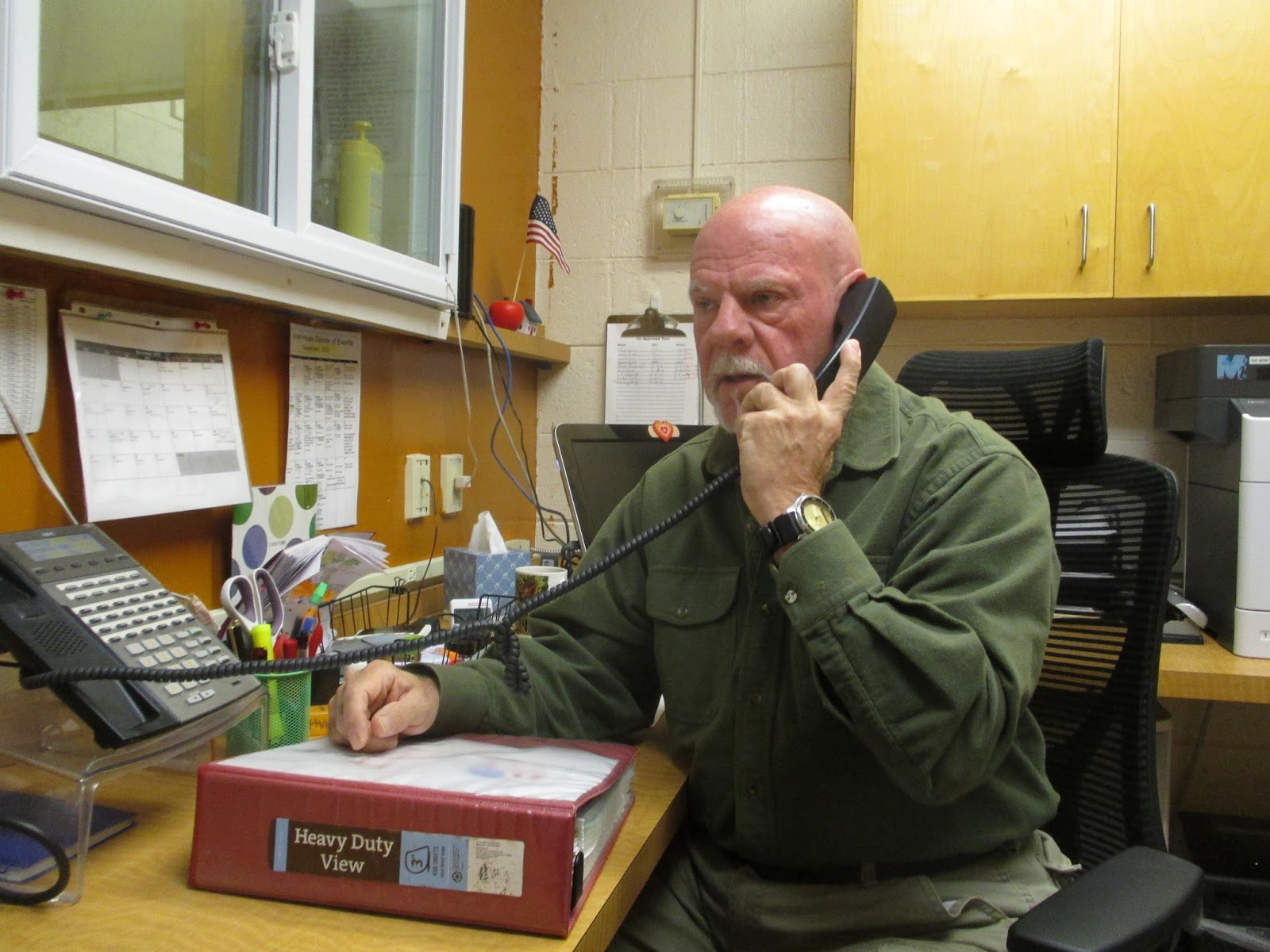
RIDDLE SERVES AS RN/NURSING SUPERVISOR
FOR THE SERVANT CENTER
Two years ago, Riddle found The Servant Center.  Or vice versa.  “Serving as nursing supervisor at the Servant House has brought me full circle in nursing.  My duties now are similar to what I did in the military, except I do sick call for a barracks filled with homeless veterans instead of Marines.
“While the veterans under my care will not deploy to the Persian Gulf after their time at the Servant House, they will face significant obstacles transitioning from homelessness back into society.  Given that some of them have multiple medical issues, it is my job to help them make this challenging re-entry as seamless as possible.”
Kent Riddle and his son, Ben helped each other cope with their memories of war.  “Ben kept a small potted sugar maple tree in his barracks at Camp Lejeune.  He asked me to care for it when he deployed.  I planted it in our back yard and prayed over it each night until Ben came back home – it is now over 25 feet tall!”
Riddle chairs the Americanism Committee of the Greensboro Elks Club and was recently named 2016 Veteran of the Year. He has lived in Greensboro since 2005.
KENT RIDDLE MOMENTS AFTER BEING NAMED
ELKS CLUB VETERAN OF THE YEAR -- 2016

Visit www.theservantcenter.org to learn how you might serve alongside Kent Riddle.


HAPPY BIRTHDAY, MARINES


Thursday, November 10, 2016 is the Marine Corps' 241st birthday.  And a day later, Friday, November 11, is the day we honor all Veterans.

THETFORDS @ COMMANDANT'S EVENING PARADE -- AUGUST, 2016

The Navy and Marine Corps have a unique relationship that is difficult to describe to those outside of the family.  Amongst ourselves we squabble over petty differences, but banded together, the Navy and Marine Corps team is the world's most formidable fighting force.

Marine ego is rarely in short supply, so it is with some hesitation that I, as a naval officer, spend a few minutes to wish my Marine brethren a happy birthday.

Like my Navy career, family life has been entwined with the Marine Corps.  Heck, my wife works as a Civil Servant for the Marines...a "Civilian Marine" as the Commandant calls them.

Fifty-plus years ago my father joined a Marine Corps Reserve Howitzer Unit, which had recently returned from Korea.  Many in that unit returned with Purple Hearts and other decorations for bravery.  Some did not return.

A year later, he signed up for active duty and was off to Parris Island.  After four years as a Marine serving in Japan, the Philippines and onboard an aircraft carrier, he moved on to college, started a family and earned a living in the private world.  

To say the Marines were just a fond memory to my father would be an understatement...often times he woke my brother, sister and me up yelling "Reveille, Reveille" in a manner that would make any Drill Sergeant proud.  At least he did not throw the trashcan...  

A cousin and three of his classmates served as Marine riflemen during World War II.  They fought -- and all four gave their lives -- in places that read like the USMC Hall of Fame...Tarawa, Tinian, Iwo Jima and Okinawa.

While researching the service of my cousin who died on Iwo Jima, I was honored to meet John Murphy, a Marine who as a Corporal in 1945 earned the Purple Heart on Iwo Jima.  He helped me dig through records at the Marine Corps Historical Center at the Navy Yard.  I have a picture with him, proudly standing next to the historic flags that were raised over Mount Suribachi.

OL'HARRY THETFORD & BGEN FRED SISLEY USMC (RETIRED)

Anyone who has worked with the Marines has something to say about them.  President Reagan looked at Marines quite favorably and said, "Some people spend an entire lifetime wondering if they made a difference.  Marines don't have that problem!"  

First Lady Eleanor Roosevelt noted, "The Marines I have seen around the world have the cleanest bodies, the filthiest minds, the highest morale, and the lowest morals of any group of animals I have ever seen!"  

Then she added, "Thank God for the United States Marine Corps!"

I frequently remind my Dad that the Marine Corps is just another part of the Department of the Navy.  And he fires right back, "Yeah, the Men's Department!"  

Marine recruits are strong, cocky and undisciplined when sent off to boot camp.  There they meet their Drill Instructor - Stronger, Cockier, the Inventor of Discipline.  

Among other things, their D.I. teaches them "To err is human, to forgive is divine.  However, neither is Marine Corps policy!"  He will likely remind them, "All men and women are created equal, then some become Marines."

MARTHA THETFORD AND CAPTAIN HARRY THETFORD JR. USN AT
MARINE CORPS COMMANDANT'S EVENING PARADE, AUGUST 2016

I've had the privilege, and the headache, of working with Marines during many Navy assignments.  Every moment of frustration in dealing with Marine "logic" has been countered by a moment of amazement in the way the Marines can get things done.  

So to my Marine brothers and sisters, while I may enjoy giving you a hard time, I know whom I'll want on my team when the balloon goes up.      

Happy Birthday Marines! 

Captain Harry Thetford Jr. USN

A special thanks to my father...my favorite Marine and source for much of this material.  
SUMNER SUBMARINER

A U. S. submarine came upon an unsuspecting convoy of Japanese ships in the Java Sea on March 15, 1945.  After the sub torpedoed the lead ship, the second ship peeled off to counterattack, whereupon the submarine torpedoed the third ship and quickly submerged.

After hitting the ocean floor at a depth of 100 feet and miring in 10 feet of mud, the sub became unnavigable – the crew of the USS Bream lay helpless as a five-hour barrage of over 25 depth charges rained around their boat.

HOWARD CLARK -- USS BREAM SS-243

Retired Greensboro businessman, Howard Clark, was a Fireman 1st Class on the Bream, “I can assure you every crewmember was praying hard that night, only God could have gotten us out of that predicament.”

Six decades later, Clark believes prayers worked for him again, “My wife, Joan, was diagnosed with scleroderma.  Johns Hopkins doctors gave her a year to live.  Submariner prayer chains across the country interceded for her, God gave us seven more years together – she died in 2004 at the age of 69.”

After graduation from Sumner High School at 16, Clark worked in a Newport News, Virginia shipyard, “I came home and decided to join the Navy – it was a chore getting in, since I had just quit a draft exempt job.”

Ordinarily, Clark would have left for the war zone after boot camp at Bainbridge, Maryland, diesel school at Dearborn, Michigan, and submarine school at New London, Connecticut, “However, I heard about a secret two-week testing program, with the caveat of a one-week leave for home.  Twelve of us volunteered.” 

He is quick to admit, “That was the craziest thing I ever did – they tested mustard gas suits on us at Walter Reed Hospital, I still have blisters to show for it, but received no major damage!”  A VA-funded study recently linked the tests with a long list of adverse health effects, and provided a toll-free number for assistance.

Clark took a troop train to San Francisco, a troopship to New Guinea, a freighter to Brisbane, Australia and rail-car to Freemantle, where he eventually went aboard the USS Bream.

Discounting the five-hour barrage of depth charges, Clark has fond memories of his World War II submarine service, “We rescued a P-51 pilot on one occasion and later searched for the crew of a downed B-25.  Even though both planes went down in enemy waters, we were able to rescue five of the six aviators.

Before transferring the aviators to other vessels we were attacked by Japanese bombers.  The aviators became quite antsy, and told us they much preferred dropping bombs from the sky to taking bombs in the water.”
 
Another favorite memory involves landing teams of Australian commandos, “We dropped them off for raids on several islands and recovered those who survived later – they were the bravest men I’ve ever known.  After the war, we learned that two of the commandos had been captured and beheaded.”
 
The USS Bream was being overhauled in San Francisco when Japan surrendered.
“After the war, I joined my dad, who was operating a service station at 535 South Elm Street.  Earl Noble, whose fighter pilot son had been killed in World War II, operated a Hertz truck rental from our station.  He introduced me to the Hertz folks in Richmond.  In 1948, they sent us one rental car.”

Over the next 40 years, Clark’s Hertz rental operations expanded to the point that cars were ordered by the hundreds.  Operations moved through various Greensboro locations -- East Washington Street, the King Cotton Hotel, East Market Street, the airport and Sycamore Street -- as well as several other Triad locations and Fayetteville.  “Our business progressed well, but at a cost, I worked two shifts, seven days a week for at least 15 years.”

HOWARD CLARK LIKED TO SUBMARINE HIS
FRIENDS AT FRIENDS HOME WEST
Howard Clark’s submariner roots still run deep.  At 92 years of age, he is active in the U.S. Submarine Veterans, Inc. and attends numerous submariner functions and reunions. 

Visitors to the Carolina Field of Honor will see numerous submariner pavers – most of them placed there, thanks to Clark’s insistence that World War II submariner service never be forgotten.

He regularly returns to the North Carolina Submarine Memorial for the annual Toiling of the Bells, memorializing the 52 U.S. submarines and 3500 crewmen, “overdue and presumed lost,” in World War II.  The submarine service made up only two percent of Navy personnel, but sank over 55% of all enemy ships sunk in the Pacific.

A search for this Submarine Memorial is well worth the effort, but don’t search along the coast -- it is located on Moonshine Mountain, just outside Burnsville, North Carolina, which is a story to itself.

Another story is for the claustrophobic who insist submariners must live like family while submerged for months at a time.  Clark disagrees, “We couldn’t have lived in those sea-going sewer pipes if we acted like a family – we had to live like we trusted each other with our lives – which we did.”

HOWARD CLARK DIED 17NOV2016, AFTER THIS COLUMN HAD BEEN SUBMITTED FOR PUBLICATION.  THE FAMILY ASKED THAT IT GO FORWARD -- IT WAS PUBLISHED SATURDAY, 19NOV, HIS MEMORIAL SERVICES WERE SATURDAY 26NOV2016.


Sunday, September 25, 2016

RETIRED ASHEBORO FIRE CHIEF INADVERTENT WITNESS TO WORLD HISTORY

“I am the last person on earth who can tell this story first person,” said 93-year old John McGlohon.  His audience overflowed the Asheboro Public Library to the point I suspected the Fire Department might ask some to leave. 

JOHN MCGLOHON LOOKS OVER MAXINE FEREBEE PRUITT'S MEMORABILIA
HER BROTHER, TOM, WAS BOMBARDIER ON ENOLA GAY

That concern became moot when the Asheboro mayor introduced McGlohon, “John started as a voluntary firefighter in 1948, came on full-time with fire department in 1955, and retired in 1985 as fire chief.  He also served 18 years on the Asheboro City Council.” 

Obviously, no one would be leaving at the Fire Department's bequest until the chief had his say.

When a standing room only crowd turns out on a steamy summer evening – for a speech by a retired public servant – expectations rise.  John McGlohon fulfilled all expectations, and more.

He and his older brother, Robert Ashley McGlohon, were born in Guilford County but the family moved to Asheboro when the boys were very young.  The older brother became an Army Air Forces bombardier and killed in action during World War II.

As a photographic specialist, Technical Sergeant John McGlohon flew reconnaissance/mapping missions over South America while mapping the Southern Ferry Route to Europe.  He helped map the Alaska Highway and chart the air route over The Hump between India and China. 

THIS B-29 CREW SURVIVED BEING IN THE WRONG PLACE AT THE RIGHT TIME
T/SGT JOHN MCGLOHON IS THIRD FROM LEFT (STANDING)

The August 6, 1945 mission for his B-29 crew was to map Japanese coastlines in preparation for the Invasion of Japan.

While McGlohon’s crew took off from Guam on their 15-hour mission, another Tarheel’s B-29 took off from Tinian.  Mocksville’s Tom Ferebee was the bombardier aboard that aircraft, the Enola Gay.  Neither of the B-29 crews realized the other was in the air.

The Enola Gay made history that day – for McGlohon’s aircraft – not so much.  At least, not so much for 50 years.

Per McGlohon, “Back on Guam that evening, we learned about the Hiroshima bombing.  Having seen and photographed the humongous blast, we surmised a bomb had hit a fuel or ammunition dump – my photos would verify the hit for the pilot.

In those days, film came in 9½ inch by 500 foot long rolls.  I didn’t stick around for processing, since the word was out that the war would end soon.  I didn’t even get to say goodbye to all my crew-members.

Nagasaki was hit on August 9, Japan surrendered on September 2.  I was back home in Asheboro by October 5, 1945.  I haven’t had the urge to leave since.”

T/SGT JOHN MCGLOHON

McGlohon told family and friends about his Hiroshima photographs, “A few newspapers carried my story.  I made a good number of talks.  The military higher-ups remained in denial – I couldn’t have cared less.”

Over 50 years after taking the only close-range photos of the Hiroshima mushroom cloud, McGlohon attended a reunion of his outfit in Tampa, “I walked in and saw the photograph I had taken displayed on the wall!  It was still labeled top secret, and dated August 6, 1945.  I told my wife, that’s the photo I took!”

While McGlohon, the only surviving crew member, has quietly maintained his resolve about the photo over the decades, questions and accusations have come and gone.  As Joe Knox wrote in the Greensboro Daily News on August 3, 1975, “It was an accident.  It was a mistake.  They (3rd Photo Reconnaissance Squadron) shouldn’t have been there.”

On a brighter side, Chatham County’s Ken Samuelson interceded for John McGlohon.  After two years of interviews and meticulous research, Samuelson documented McGlohon’s claim to his photo taken over Hiroshima on August 6, 1945.  Among other things, Samuelson discovered McGlohon’s photo had been published by a military newspaper as early as August 11, 1945 – with no credit to the photographer.

McGlohon now has the rest of the story – an officer in the Guam Army film laboratory saved the film and brought it back to the States after the war.  Following his death, it was donated to the Historic Aviation Memorial Museum in Tyler, Texas.

HOMETOWN HERO, JOHN MCGLOHON, DREW STANDING ROOM ONLY CROWD

McGlohon married a former Army nurse cadet in training, Marietta Jane Gellback, on April 30, 1948.  She is now deceased.  They were active members of Asheboro’s First United Methodist Church.  They had two sons, Bob and Steve, two grands, and five great-grand-children.

After the war, McGlohon operated an Asheboro photography studio for several years and even served a stint as photographer for the Greensboro Daily News.


Saturday, August 6, 2016

OLYMPIAN IN OUR MIDST

While Colonel Guy Troy, U.S. Army (Retired) was a late bloomer as a modern pentathlon athlete, it did not keep him from winning a gold medal in the very first Pan American Games 1951 in Buenos Aires.  It wasn’t lost on Troy that another Armored Army officer finished fifth overall in the same sport in the 1912 Olympics at Stockholm.  That soldier’s name was Patton.

“Having served as a Cavalry Platoon Leader in Europe, I would have been happy if the Army had sent me directly to the Korean War from Buenos Aires after the Pan-Am Games.  Instead, they sent me to West Point to form and recruit a modern pentathlon team and start training for the 1952 Olympics in Helsinki,” Troy recalled from his home in Liberty, North Carolina.

Perchance you know more about shooting baskets or pool than pentathloning, here are the Cliff’s Notes of competitive events: Fencing, pistol shooting, 200 meter free-style swim, 4000 meter horseback ride with 25 jumps, and 4000 meter cross-country run.

During Olympic try-outs, player/coach Troy did well his first two days, “I was first in fencing, second in shooting, and sixth in swimming.  I was about six years older than most of the runners and came in eighth.  My wheels did not run off in the horseback competition, but my horse did – she fell about half way to the finish line.”

TROY POINTS TO TAG REPRESENTING
 HORSE HE DREW IN 1952 OLYMPICS
Troy finished fourteenth in individual completion and coached his team to a fourth place position in those 1952 Summer Olympics, “Actually, we tied with Finland for third, but they won the bronze medal because they beat us in the cross-country.”

He holds no grudges against his Olympic steed, “That horse had some age on her.  She did the best she could.  After all, she was one of 14 hand-me-downs sent to us from Fort Riley, Kansas.”

At 93, and retired to his Liberty, North Carolina farm, Troy is still an Olympic enthusiast.  “Will I be watching the events in Rio de Janeiro?  You bet!”  

FORMER OLYMPIAN GUY TROY RECEIVED
EARLY COPY OF 2016 PROGRAM FROM RIO
He has served in many Olympic capacities, including event judging in 1972, 1980, 1984 and 1990.  He fondly recalls witnessing the 1980 “Miracle on Ice” at Lake Placid. 

Even though the Pan American Games and Olympic competition kept Troy from Korea, he later commanded an Armored Reconnaissance Unit.  He served in Vietnam as intelligence officer for the 25th Infantry Division in 1967-1968.

Although Troy is a graduate of West Point, he originally enlisted as an aviation cadet in the Army Air Corps in 1942.

“I already knew how to fly.  When the war started, I knew I wanted aviation.”  During aviation training, he was selected for the Academy in 1943 and graduated in 1946.  He served Cold War assignments in Germany and Austria before and after his pentathlon competition.  In 1959-1960 he served as a Military Adviser in Iran.

Troy married Winifred Hildegarde Charles, who died in 2009.  They had two sons, Guy K. Troy Jr., a West Point graduate and retired military, and Thaddeus W. Troy, a 30-year CIA employee.  There are four Troy grandchildren.

FRANK HEBERER (L) AND GUY TROY
TWO RETIRED COLONELS WHO SERVED TOGETHER IN
CONSTABULARY FORCE AFTER WW II
Troy’s father, Dr. Thaddeus Troy, practiced medicine in Greensboro for many years.  He and Dr. Wesley Long III were cousins.  Dr. Troy served in World War I and retired from the Army Reserve as a colonel.

There is another colonel of interest in Guy Troy’s lineage – Colonel Andrew Balfour.  According to Troy, ‘He is my great-great-great grandfather.” Balfour’s tombstone on Doul Mountain in Randolph County reads, “ …murdered by a band of Tories at his home.”

Balfour’s execution by the notorious loyalist leader, David Fanning, was one of many such incidents in the Piedmont wherein Whigs were gunned down during the unofficial “Tory War” in early 1782.  It has not gone unnoticed by the folks of Randolph County.  An Asheboro community is named in Balfour’s memory, as is a DAR Chapter and Masonic Lodge.

Obviously, Troy is a man of many interests – in his Liberty environs of several hundred acres, he has farmland and timberland, “Right now, I would have to say, my passion is forestry!” 

He has his own tennis courts.  Even though he has ample room for a golf course, he opted out, “Golf takes too much of my day – I have other things to do.”

Troy is a founder and active member of All Souls Anglican Church in Asheboro.  He also serves with the Randolph County Honor Guard, which conducts hundreds of military funerals each year for veterans across the Piedmont.  He is active with the West Point Society.

RETIRED ARMY COLONELS  FRANK HEBERER AND GUY TROY AT
TROY'S FARMHOUSE IN LIBERTY, NC
DECEMBER, 2015


Saturday, July 9, 2016

MODERN DAY MARINE

Never underestimate the importance of a highway sign. 

While stationed at Camp Lejeune in 1991, Dan Clark read from a sign that Greensboro was an All-America City. “I came here often, Greensboro may not be world renowned as a liberty town, but compared to Jacksonville...”  Upon his discharge in 1992, Clark settled in his favorite liberty town.

PARRIS ISLAND GRADUATE
Clark joined the Marine Corps at 17, after his parents signed the approval papers, “I had to wait several months for an opening at Parris Island, but left my hometown on Christmas Day, 1988.”  After Boot Camp and Radio School, Clark completed deployments as a field radio operator on Okinawa and in Korea before receiving orders to Camp Lejeune, NC.

Almost immediately after arriving, Clark deployed to the Persian Gulf area as a radio operator with the 10th Marines in preparation for Desert Storm.  “We spent eight months practicing amphibious assaults and field exercises in various Gulf countries.  Compared to the build-up, the war was over in the blink of an eye, but friendships built during those times will last a lifetime.”

Clark wasted no time acclimating to Greensboro.  On his way to a Guilford College degree in political science, he first graduated from GTCC.  All the while, he worked as a part-time tire salesman for Sears and later as full-time Auto Center supervisor until he became store manager of the Sears-owned National Tire & Battery Store in Winston-Salem.

“Even though I thoroughly enjoyed college and working at Sears, I truly missed the Marine Corps.”  Clark found the perfect compromise – the Marine Corps Reserve.  After joining the Reserves in 1993 he was assigned to the Greensboro-based Marine Corps Reserve Unit.

Over the next several years Clark deployed to locations around the world, including Germany, Norway and the Arctic Circle before deploying in 2003 with the Greensboro Reserve unit for Operation Iraqi Freedom as Data Communications Chief.

DAN CLARK PROGRESSED THROUGH LEADERSHIP POSITIONS
IN RADIO, COMPUTERS & INFORMATION TECHNOLOGY
After returning from Iraq, Clark served in several locations around the country, fulfilling the duties of Data Communications Chief and later Company First Sergeant, which brought him full circle back to Greensboro.   

After successful tours as First Sergeant in Greensboro and later Tampa, Florida, he was promoted to Battalion Sergeant Major and completed tours of duty in Newport News, Virginia as well as Aurora, Colorado and Fort Worth, Texas.

In May, 2016 Clark reported to the Marine Corps Reserve Unit in Charlotte for his final tour.  He will face mandatory retirement in May, 2018 after completing 30 years of military service -- at the age of 47.

Clark is the first to admit that the Marine Corps isn’t for everyone, “I joined straight out of high school from the small town of Kissimmee, Florida.  Since I did not have grades, money, or focus for college, the Marine Corps looked to be a way I could grow up, prove my mettle, gain work experience, and travel beyond Florida and Mickey Mouse.”  

It seems to have done all of that for him.

One other tidbit about Reserve service – mandatory attendance, “Admittedly, my commutes were longer and more complicated than most, but I wouldn’t have had it any other way.  Long weekends of Reserve duty made Monday mornings especially tough, and duty in the summer sometimes came at the worst possible times.”

When asked about social media’s impact on warfighting, Clark responded “Instant communication is here to stay, but I’ve seen it get too many Marines in trouble, albeit unintentional.  Elements of combat can be taken out of context – the horrors of war don’t need videoing back home or posted on social media.”

Suspecting Clark had no time for hobbies, he surprisingly admitted to saltwater fishing and running as two of his favorite pastimes, completing two Marine Corps Marathons and numerous other events.  In addition, he and his wife Kathy have organized multiple 5K and 10K fundraising events for Hope for the Warriors and other charitable causes.

DAN CLARK -- 2016 -- TWO YEARS FROM RETIREMENT
Sergeant Major Clark has served in every enlisted rank and two wars during his career. He has seen several generations of Marine recruits come and go.  He has a chest-full of personal decorations, and the ethos of a Marine recruiter, “Where else could a young kid lead Marines into battle, handle multi-billion dollar equipment, or fly fighter jets -- all for the good of our country?  

Nowhere!”


RICHARD CRAPSE -- MAN OF MANY SERVICES

Richard Crapse’s military service shadow box could be confusing at a quick glance.  It contains medals, decorations and awards from the Civil Air Patrol, the Marine Corps, the National Guard and the Air National Guard – all of which were stepping stones to his military retirement.

His Marine Corps service came first, 1965-1971.  “Our St. Petersburg, Florida High School senior classes cycled around the services – one year, most joined the Air Force, next year the Navy, etc.  My year was the Marine Corps’ year.”
NEWLY-WEDS KATHLEEN & RICHARD CRAPSE -- 1969
That was also the year recruit training at Parris Island was shortened from 12 weeks to eight weeks, “All that did was shorten the time between being a civilian and serving in Vietnam by one month – the Parris Island experience remained the same.”

Actually, Crapse was given a choice between Arctic Survival Training or Vietnam, “I didn’t figure a Florida boy would fare well in the Arctic, so by year end, I was lobbing 105mm howitzer shells into the Vietnam jungle.

Our guns were of World War II vintage and needed rebuilding after firing 50,000 rounds.  Several big wheels came out in the jungle to our battery to congratulate us upon firing our 100,000th round – at 150,000 rounds we were withdrawn for refitting on Okinawa.”

As for World War II, Crapse recalls eating C Rations of that vintage as well, “They still tasted OK.”

From Okinawa, Crapse made brief stops in the Philippines and Taiwan before his 105mm battery was assigned to a Battalion Landing Team operating from an LST off Vietnam, “With amtracs, helicopters and small boats, we could do about any type mission.  We took casualties of all sorts – from enemy fire, friendly fire, and others from crashes and accidents.

At times, North Vietnam artillery was incoming from our front and big guns from the Navy were incoming from our rear.  Those were the times I wondered how it was in the Arctic!
During one operation, we were too far inland to resupply from the beach and the jungle too thick for helicopters to land, so we had to improvise.  We took five-gallon cans to a river for water, and made a bath call while there.  The enemy jumped us in our birthday suits, but we had enough Colt 45s close by to ward them off.”

While Crapse was flown into Vietnam in an air-conditioned airliner with stewardesses, getting out was more complex, “Offshore, aboard a Navy ship, I was told I had been rotated and that a helicopter would pick me up.  It never showed and the small boat I could have caught left the ship before my gear could be loaded. 

I was finally helicoptered to Da Nang, but my orders could not be located.  I missed the short-timer flight from Okinawa by one day.  While in the waiting mode, a typhoon came through and blew away the shed in which my seabag had been stored.  Most of my personal gear and uniforms were lost.

After traveling on emergency orders, I reached Travis Air Force Base and eventually made it to safe haven at Camp Lejeune.”

Later, Crapse interviewed for duty at Marine Barracks, Washington, D.C., home of the Marine Corps Band and ceremonial drill teams.  “I told them, no thanks, but they told me it was an order, not an invitation.

I was honored to be at Marine Barracks, but did not want to stay, so I signed waivers to go back to Vietnam.  Instead, they sent me to Jacksonville, Florida, where I signed more waivers to go back to Vietnam.  This time they worked, but only got me as far as Okinawa and Japan for a year or so.”

It was back to Camp Lejeune in 1971, where Crapse was again ordered to Washington, D.C. – this time to quell Mayday protests.  “We were dropped into the Mall to take back the Washington Monument from protesters – the Park Police had given it up and taken cover inside the Monument.

The next day’s Washington Post identified us as secret storm troops.”

Crapse admits that his time at Marine Barracks wasn’t all bad, “I escorted six girls to an Evening Parade one Friday evening.  I shuffled five of them off to buddies, but kept one for myself – Kathleen Pummer, from Allentown, Pennsylvania, and I have been married 47 years.”
RICHARD & KATHLEEN CRAPSE -- 2016
Kathleen has a master’s and law degree from Campbell University.  Her law practice was in Reidsville, where they have lived for the past 24 years.  Richard Crapse has worked in law enforcement and the Greensboro Housing Authority.